
Classique Tourbillon Sidéral 7255
7255PT/2N/9VU
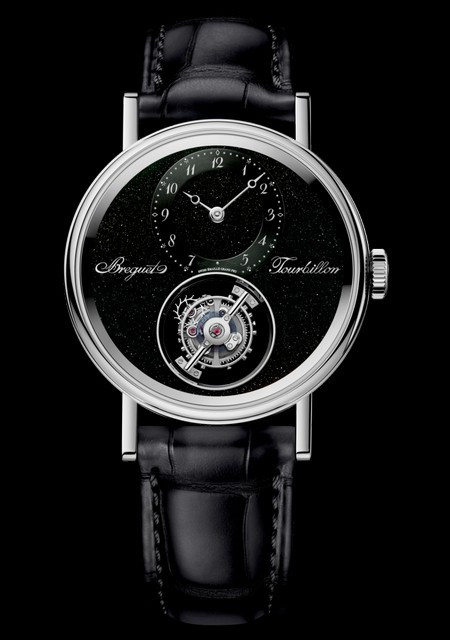
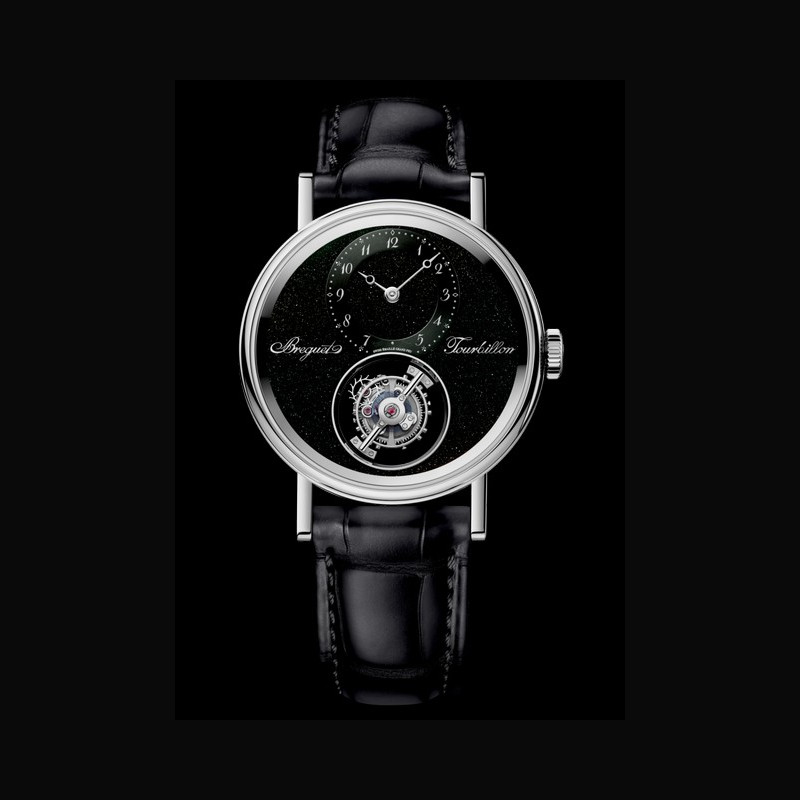
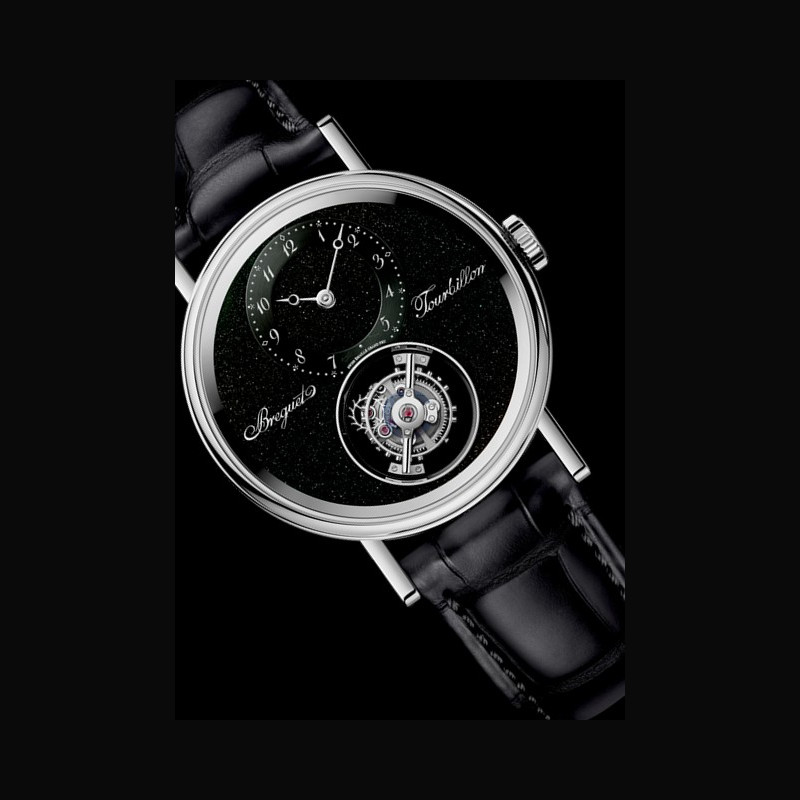
| Brand : | Breguet |
| Collection : | Classique |
| Model : | Classique Tourbillon Sidéral 7255 |
| Reference : | 7255PT/2N/9VU |
| Complement : | 950 Platinum - Black Dial - Strap Alligator Leather |
| On sale : | 2026 |
PDF INDEX CARD


-
Brand : Breguet Collection : Classique Model : Classique Tourbillon Sidéral 7255 Reference : 7255PT/2N/9VU Complement : 950 Platinum - Black Dial - Strap Alligator Leather On sale : 2026 List Price : 261 400 € Diameter : 38 mm Thickness : 10.2 mm Styles : High Horology Types : Hand-winding Calibre : 187M1 Calibre distinction : Côtes de Genève Patented blue Breguet Nivachron® balance-spring Rhodium-plated 18K Breguet gold mainplate and lower bridge Complication : Hours Minutes and seconds on the Tourbillon cage Case material : Platinum Case peculiarity : Fluted case Caseback adorned with hand-guilloché “Quai de l’Horloge” motif Welded lugs Shape : Round Water-resistance : 30 meters Dial : Aventurine Grand Feu enamel Dial color : Black Display : “Breguet” and “Tourbillon” appliques in rhodium-plated 18K gold Breguet Arabic numerals Breguet hours and minutes hands in rhodium-plated 18K gold Glass : Sapphire Double Anti-Reflective Strap material : Alligator leather Strap color : Black Strap clasp : Folding buckle + More characteristics :
Movement
One-minute Tourbillon
Calibre 187M1, numbered and signed Breguet
4.8 mm thick (+2.2 mm protrusion of the Tourbillon)
30 mm in diameter, 13½ lignes
Manual winding
50-hour power reserve
Frequency 2.5 Hz (18,000 vibrations per hour)
Patented blue Breguet Nivachron® balance-spring
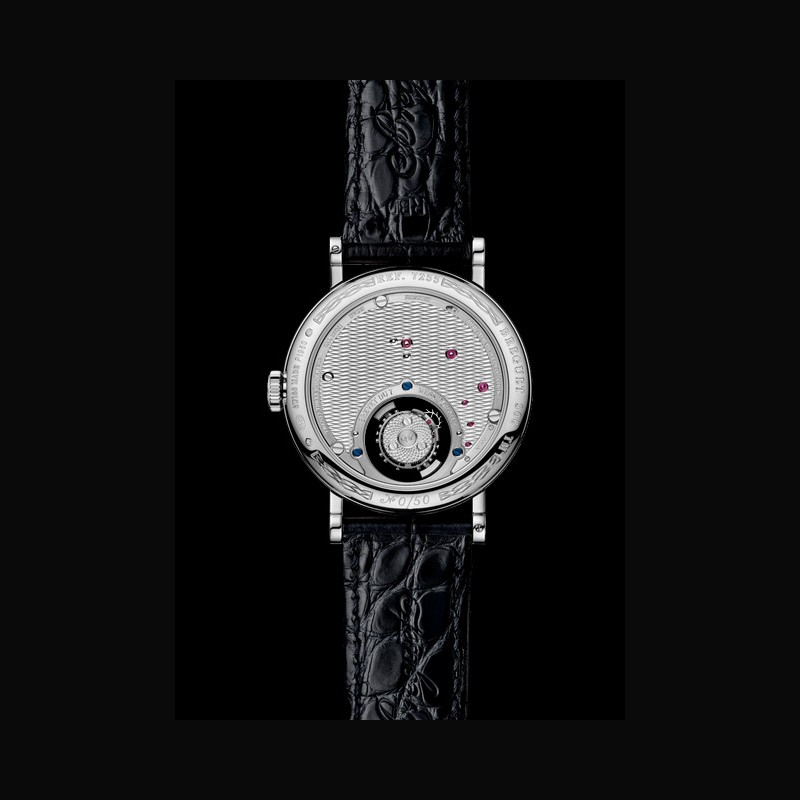
Rhodium-plated 18K Breguet gold mainplate and lower bridge “Quai de l’Horloge” and “Côtes de Genève” guilloché finishes
183 components
23 jewels
Case
950 platinum
Dial
Black aventurine Grand Feu enamel with green highlights
Strap / Buckles
Black large-scale alligator leather lined with black small-scale alligator leather
Triple-blade folding clasp in 950 platinum
Weight of 950 platinum
~70.6 g
Weight of 18K gold
~35.4 g
Limited edition
50 timepieces, numbered and hand-engraved from 1/50 to 50/50 on the caseback
Warranty
5-year international warranty

DESCRIPTION
1801–2026: 225 years since the invention of the Tourbillon
Breguet celebrates the Tourbillon legacy with a number of exclusive creations
In 2026, Breguet pays tribute to the invention of the Tourbillon, for which Abraham-Louis Breguet was granted his historic patent on 7 Messidor Year 9 according to the French revolutionary calendar, corresponding to 26 June 1801. This means that this eminent complication has been an enduring part of day-to-day life for the Manufacture Breguet, its collectors and the entire watch industry – which has since widely adopted its founding principle – for exactly 225 years.
Since then, the Manufacture has continued to foster the progress of the great watchmaker’s invention, constantly drawing on its original inspiration, while over the decades introducing valuable technical refinements serving a single purpose: the quest for precision. All the new models presented today are part of this vision.
An invention at the heart of history
1793: the turmoil of the French Revolution eventually convinced Breguet to leave his workshop on the Quai de l’Horloge and enjoy a much-needed escape with his family. In Neuchâtel and subsequently in Le Locle, the watchmaker took advantage of this respite to revisit some of his creative visions and contemplate the future of his company.
Upon his return to Paris in 1795, Breguet unveiled a number of inventions that would prove decisive not only for his own future, but also for that of horology as a whole: the sympathique clock (a clock that sets the time of a pocket watch that is placed on top of it), the souscription watch (whose minimalist design redefined the aesthetic codes of watchmaking, and which the House of Breguet reinterpreted in 2025), along with the à tact watch (serving to read the time by touch), among many others.
A.-L. Breguet developed two new mechanisms: firstly, the constant-force escapement, patented in 1798 and secondly, a Tourbillon regulator device patented three years later in 1801. It is the latter that we are now celebrating on its 225th anniversary.
Origins of a watchmaking revolution
The Tourbillon regulator, or Tourbillon, is based on the observation that the oscillation of certain watch components – and more critically the balance and balance-spring – is “pulled” downwards by the force of gravity. The regulation organ’s operation is thus affected, and indeed unevenly so, when the watch is held vertically – which was almost always the case for a pocket watch in Breguet’s day.
To resolve this difficulty, Breguet was naturally aware that he could not defy the laws of gravity. In a sense, he therefore circumvented the problem by inventing a system based around a cage (also known as a cage) in which the escapement and the regulating mechanisms (balance and balance-spring) are enclosed and kept in constant rotation around an axis, in all positions. The balance-and-spring assembly’s centre of gravity is thus continually realigned with the axis of rotation, compensating for the adverse effects of the uneven oscillation of a watch held in a static position. Breguet designed this system to “mix up” all vertical positions and ultimately achieve higher average accuracy.
If we consider that the Tourbillon took shape in Breguet’s mind between 1793 and 1795 (during his stay in Switzerland), six years elapsed between his return to Paris and the granting of the patent on 26 June 1801 – and a further six years would pass between the official approval of this patent and the first sales.
Breguet and his employees went on to produce 40 Tourbillons between 1796 and 1829, along with nine other such timepieces that were never completed and are recorded in the accounts as written off, scrapped or lost.
Since then, the Manufacture has never ceased striving to perfect this mechanism – one of the trickiest and most complex in the realm of Haute Horlogerie – in order to open up new chronometric horizons. With this in mind, the House continues to develop new watchmaking processes (high frequency) and also ventures to explore other disciplines with a view to enriching the Tourbillon with the latest scientific breakthroughs (such as the constant-force magnetic escapement).
Classique Tourbillon Sidéral 7255
An iconic creation among the timepieces unveiled as part of the 250th anniversary celebrations, the Classique Tourbillon Sidéral 7255 is the first Breguet wristwatch to feature a flying Tourbillon. This model also incorporates a “mysterious” display, a watchmaking construction that Breguet had not used for nearly 20 years.
A word from Gregory Kissling, CEO of Montres Breguet:
“The very word ‘Tourbillon’ carries astronomical connotations that Breguet had in mind. Based on a solid background in what we now call astrophysics, he designed scientific measuring instruments that he kept separate in his records from his regular production. The Tourbillon is therefore both the central mechanism of chronometric excellence and a direct evocation of the solar system as it was mapped in the 18th century. With this unique black aventurine enamel dial, we offer a reminder of how closely these worlds are linked by one and the same man: Abraham-Louis Breguet.”
The flying Tourbillon
In developing its first flying Tourbillon, Manufacture Breguet is following in the footsteps of the great watchmaker. The House continues to cultivate his spirit of constant innovation, returning to the foundations of the Tourbillon to offer a design that is distinctive in two respects: both flying and mysterious.
The flying Tourbillon is a variation on the traditional Tourbillon invented by A.-L. Breguet. Its purpose (to counteract the effects of gravity on the balance by rotating the cage enclosing it) remains unchanged.
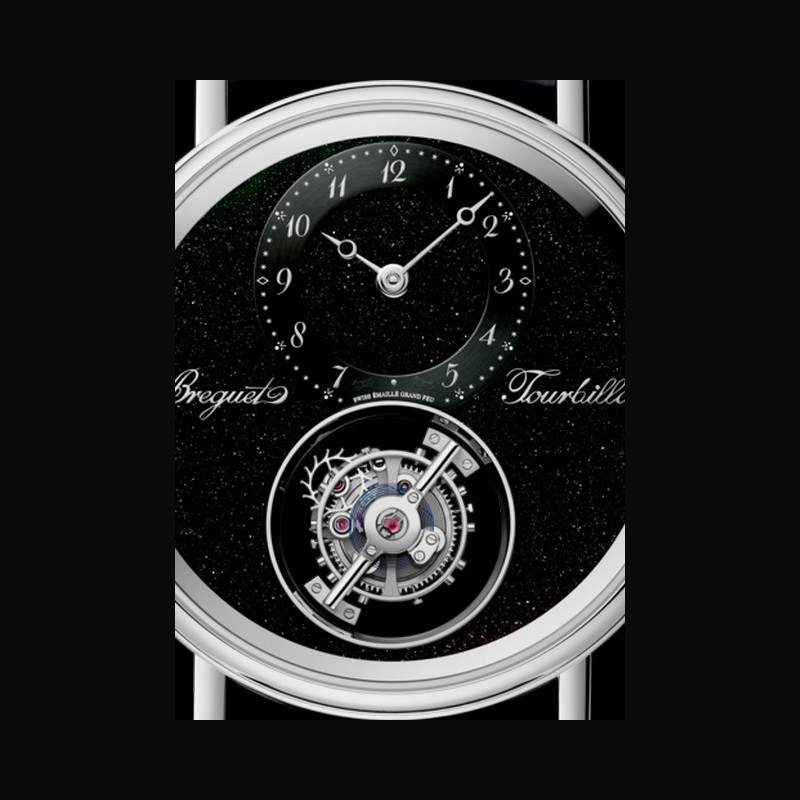
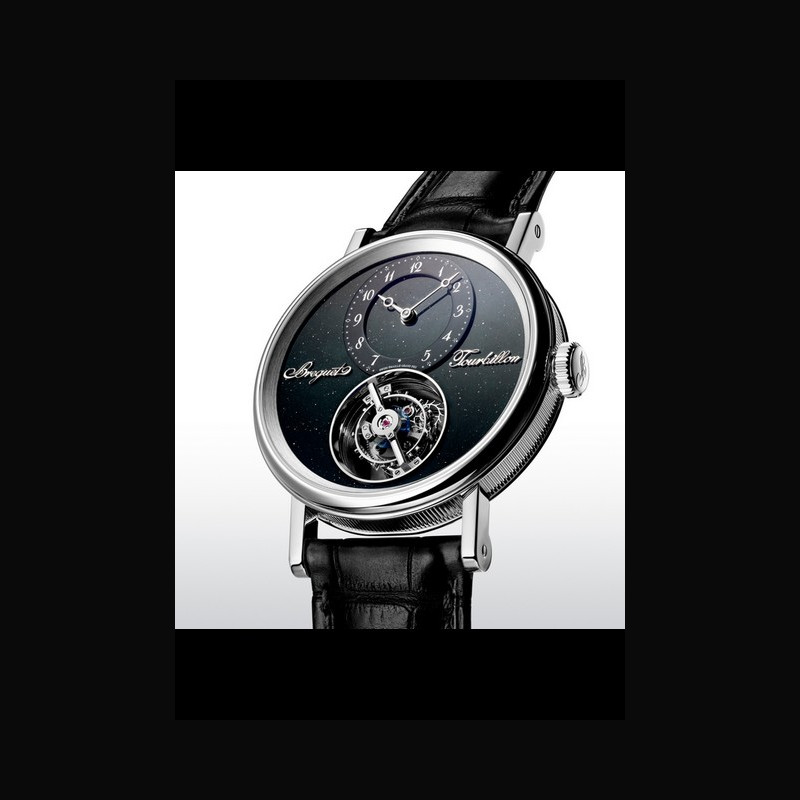
Unlike the traditional Tourbillon, the flying Tourbillon has a cage held only by its lower bridge, with no upper bridge. It is therefore supported solely from below, giving the impression that it is floating in mid-air, hence its name. Its construction is however more complex, as the pivot of the Tourbillon cage is no longer supported on both sides, but only at its base. This requires greater robustness, finer adjustment and better poising.
The mysterious display
To accentuate the suspended effect of its flying Tourbillon, Breguet has complemented it with a mysterious construction, a technique dating back to the late 19th century. The mysterious complication involves setting a component into motion without it being visibly connected to the rest of the movement. While this most often applies to hands, any other organ may be involved. Including the Tourbillon that is the focus of the Classique Tourbillon Mystérieux 7255.
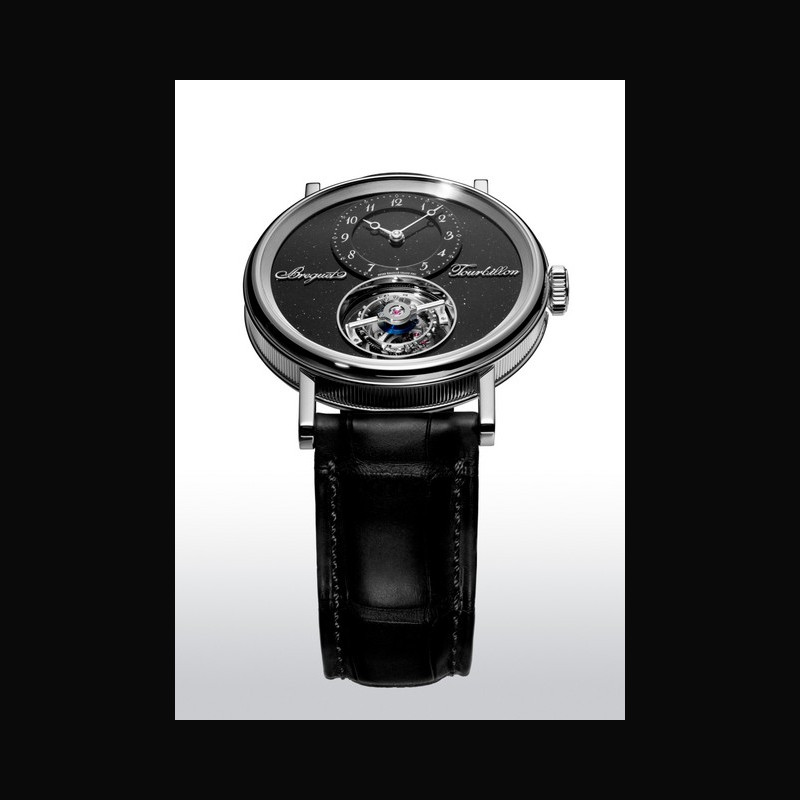
Despite its particularly striking appearance, the mysterious Tourbillon is in fact quite simple in design: the gears that connect its cage to the rest of the movement are very much present, yet invisible due to the fact they are made of anti-reflective sapphire crystal.
The Tourbillon’s historical roots in astronomy
The presence of a Tourbillon in a timepiece recalling Breguet’s astronomical achievements is rooted in a particular historical context. The contemporary meaning of the Tourbillon is indeed very similar to what its original French etymology suggests: “that which rotates rapidly and in a circular motion”.
This was however not the case in the 17th and 18th centuries. At that time, the mathematician Blaise Pascal broadened the meaning of the Tourbillon to that of a “material system animated by rotational motion”. The concept of the Tourbillon was thus extended to planetary systems, hence its direct link to astronomy, a science that Breguet studied during his training under Abbé Marie at the Collège Mazarin, and which the great watchmaker would continue by joining the Académie des Sciences, as well as the Bureau des longitudes in Paris, dedicated to the advancement of the various branches of astronomy. Furthermore, in the early years of developing his Tourbillon, he regularly associated with the astronomers Lalande, Biot, Bouvard, Nicollet and Cassini, as well as François Arago.
A brand-new version for the Tourbillon’s 225th anniversary
The new Classique Tourbillon Sidéral 7255 features a platinum case with a black aventurine enamel dial. This new colour scheme reinforces the link between the timepiece and its astronomical heritage.
For the occasion, the chapter ring is crafted from gold and treated with a black finish. The “Breguet” and “Tourbillon” appliques are in rhodium-plated Breguet gold, as is the upper Tourbillon bridge. On the caseback, the watch features a Quai de l’Horloge-guilloché mainplate. The movement is hand-wound and endowed with a 50-hour power reserve.
The watch is issued in a 50-piece limited edition.
1801–2026: 225 years since the invention of the Tourbillon
Breguet celebrates the Tourbillon legacy with a number of exclusive creations
In 2026, Breguet pays tribute to the invention of the Tourbillon, for which Abraham-Louis Breguet was granted his historic patent on 7 Messidor Year 9 according to the French revolutionary calendar, corresponding to 26 June 1801. This means that this eminent complication has been an enduring part of day-to-day life for the Manufacture Breguet, its collectors and the entire watch industry – which has since widely adopted its founding principle – for exactly 225 years.
Since then, the Manufacture has continued to foster the progress of the great watchmaker’s invention, constantly drawing on its original inspiration, while over the decades introducing valuable technical refinements serving a single purpose: the quest for precision. All the new models presented today are part of this vision.
An invention at the heart of history
1793: the turmoil of the French Revolution eventually convinced Breguet to leave his workshop on the Quai de l’Horloge and enjoy a much-needed escape with his family. In Neuchâtel and subsequently in Le Locle, the watchmaker took advantage of this respite to revisit some of his creative visions and contemplate the future of his company.
Upon his return to Paris in 1795, Breguet unveiled a number of inventions that would prove decisive not only for his own future, but also for that of horology as a whole: the sympathique clock (a clock that sets the time of a pocket watch that is placed on top of it), the souscription watch (whose minimalist design redefined the aesthetic codes of watchmaking, and which the House of Breguet reinterpreted in 2025), along with the à tact watch (serving to read the time by touch), among many others.
A.-L. Breguet developed two new mechanisms: firstly, the constant-force escapement, patented in 1798 and secondly, a Tourbillon regulator device patented three years later in 1801. It is the latter that we are now celebrating on its 225th anniversary.
Origins of a watchmaking revolution
The Tourbillon regulator, or Tourbillon, is based on the observation that the oscillation of certain watch components – and more critically the balance and balance-spring – is “pulled” downwards by the force of gravity. The regulation organ’s operation is thus affected, and indeed unevenly so, when the watch is held vertically – which was almost always the case for a pocket watch in Breguet’s day.
To resolve this difficulty, Breguet was naturally aware that he could not defy the laws of gravity. In a sense, he therefore circumvented the problem by inventing a system based around a cage (also known as a cage) in which the escapement and the regulating mechanisms (balance and balance-spring) are enclosed and kept in constant rotation around an axis, in all positions. The balance-and-spring assembly’s centre of gravity is thus continually realigned with the axis of rotation, compensating for the adverse effects of the uneven oscillation of a watch held in a static position. Breguet designed this system to “mix up” all vertical positions and ultimately achieve higher average accuracy.
If we consider that the Tourbillon took shape in Breguet’s mind between 1793 and 1795 (during his stay in Switzerland), six years elapsed between his return to Paris and the granting of the patent on 26 June 1801 – and a further six years would pass between the official approval of this patent and the first sales.
Breguet and his employees went on to produce 40 Tourbillons between 1796 and 1829, along with nine other such timepieces that were never completed and are recorded in the accounts as written off, scrapped or lost.
Since then, the Manufacture has never ceased striving to perfect this mechanism – one of the trickiest and most complex in the realm of Haute Horlogerie – in order to open up new chronometric horizons. With this in mind, the House continues to develop new watchmaking processes (high frequency) and also ventures to explore other disciplines with a view to enriching the Tourbillon with the latest scientific breakthroughs (such as the constant-force magnetic escapement).
Classique Tourbillon Sidéral 7255
An iconic creation among the timepieces unveiled as part of the 250th anniversary celebrations, the Classique Tourbillon Sidéral 7255 is the first Breguet wristwatch to feature a flying Tourbillon. This model also incorporates a “mysterious” display, a watchmaking construction that Breguet had not used for nearly 20 years.
A word from Gregory Kissling, CEO of Montres Breguet:
“The very word ‘Tourbillon’ carries astronomical connotations that Breguet had in mind. Based on a solid background in what we now call astrophysics, he designed scientific measuring instruments that he kept separate in his records from his regular production. The Tourbillon is therefore both the central mechanism of chronometric excellence and a direct evocation of the solar system as it was mapped in the 18th century. With this unique black aventurine enamel dial, we offer a reminder of how closely these worlds are linked by one and the same man: Abraham-Louis Breguet.”
The flying Tourbillon
In developing its first flying Tourbillon, Manufacture Breguet is following in the footsteps of the great watchmaker. The House continues to cultivate his spirit of constant innovation, returning to the foundations of the Tourbillon to offer a design that is distinctive in two respects: both flying and mysterious.
The flying Tourbillon is a variation on the traditional Tourbillon invented by A.-L. Breguet. Its purpose (to counteract the effects of gravity on the balance by rotating the cage enclosing it) remains unchanged.
Unlike the traditional Tourbillon, the flying Tourbillon has a cage held only by its lower bridge, with no upper bridge. It is therefore supported solely from below, giving the impression that it is floating in mid-air, hence its name. Its construction is however more complex, as the pivot of the Tourbillon cage is no longer supported on both sides, but only at its base. This requires greater robustness, finer adjustment and better poising.
The mysterious display
To accentuate the suspended effect of its flying Tourbillon, Breguet has complemented it with a mysterious construction, a technique dating back to the late 19th century. The mysterious complication involves setting a component into motion without it being visibly connected to the rest of the movement. While this most often applies to hands, any other organ may be involved. Including the Tourbillon that is the focus of the Classique Tourbillon Mystérieux 7255.
Despite its particularly striking appearance, the mysterious Tourbillon is in fact quite simple in design: the gears that connect its cage to the rest of the movement are very much present, yet invisible due to the fact they are made of anti-reflective sapphire crystal.
The Tourbillon’s historical roots in astronomy
The presence of a Tourbillon in a timepiece recalling Breguet’s astronomical achievements is rooted in a particular historical context. The contemporary meaning of the Tourbillon is indeed very similar to what its original French etymology suggests: “that which rotates rapidly and in a circular motion”.
This was however not the case in the 17th and 18th centuries. At that time, the mathematician Blaise Pascal broadened the meaning of the Tourbillon to that of a “material system animated by rotational motion”. The concept of the Tourbillon was thus extended to planetary systems, hence its direct link to astronomy, a science that Breguet studied during his training under Abbé Marie at the Collège Mazarin, and which the great watchmaker would continue by joining the Académie des Sciences, as well as the Bureau des longitudes in Paris, dedicated to the advancement of the various branches of astronomy. Furthermore, in the early years of developing his Tourbillon, he regularly associated with the astronomers Lalande, Biot, Bouvard, Nicollet and Cassini, as well as François Arago.
A brand-new version for the Tourbillon’s 225th anniversary
The new Classique Tourbillon Sidéral 7255 features a platinum case with a black aventurine enamel dial. This new colour scheme reinforces the link between the timepiece and its astronomical heritage.
For the occasion, the chapter ring is crafted from gold and treated with a black finish. The “Breguet” and “Tourbillon” appliques are in rhodium-plated Breguet gold, as is the upper Tourbillon bridge. On the caseback, the watch features a Quai de l’Horloge-guilloché mainplate. The movement is hand-wound and endowed with a 50-hour power reserve.
The watch is issued in a 50-piece limited edition.
-
Brand : Breguet Collection : Classique Model : Classique Tourbillon Sidéral 7255 Reference : 7255PT/2N/9VU Complement : 950 Platinum - Black Dial - Strap Alligator Leather On sale : 2026 List Price : 261 400 € Diameter : 38 mm Thickness : 10.2 mm Styles : High Horology Types : Hand-winding Calibre : 187M1 Calibre distinction : Côtes de Genève Patented blue Breguet Nivachron® balance-spring Rhodium-plated 18K Breguet gold mainplate and lower bridge Complication : Hours Minutes and seconds on the Tourbillon cage Case material : Platinum Case peculiarity : Fluted case Caseback adorned with hand-guilloché “Quai de l’Horloge” motif Welded lugs Shape : Round Water-resistance : 30 meters Dial : Aventurine Grand Feu enamel Dial color : Black Display : “Breguet” and “Tourbillon” appliques in rhodium-plated 18K gold Breguet Arabic numerals Breguet hours and minutes hands in rhodium-plated 18K gold Glass : Sapphire Double Anti-Reflective Strap material : Alligator leather Strap color : Black Strap clasp : Folding buckle More characteristics :
Movement
One-minute Tourbillon
Calibre 187M1, numbered and signed Breguet
4.8 mm thick (+2.2 mm protrusion of the Tourbillon)
30 mm in diameter, 13½ lignes
Manual winding
50-hour power reserve
Frequency 2.5 Hz (18,000 vibrations per hour)
Patented blue Breguet Nivachron® balance-spring
Rhodium-plated 18K Breguet gold mainplate and lower bridge “Quai de l’Horloge” and “Côtes de Genève” guilloché finishes
183 components
23 jewels
Case
950 platinum
Dial
Black aventurine Grand Feu enamel with green highlights
Strap / Buckles
Black large-scale alligator leather lined with black small-scale alligator leather
Triple-blade folding clasp in 950 platinum
Weight of 950 platinum
~70.6 g
Weight of 18K gold
~35.4 g
Limited edition
50 timepieces, numbered and hand-engraved from 1/50 to 50/50 on the caseback
Warranty
5-year international warranty