
Code 11.59 By Audemars Piguet Selfwinding Perpetual Calendar Openworked
26443nb.Oo.D002cr.01

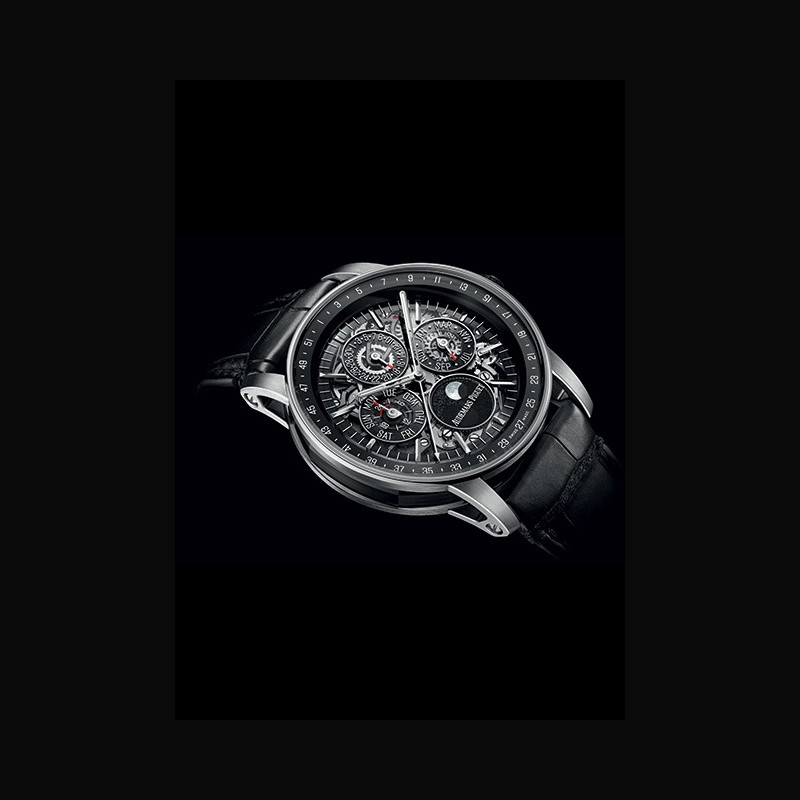
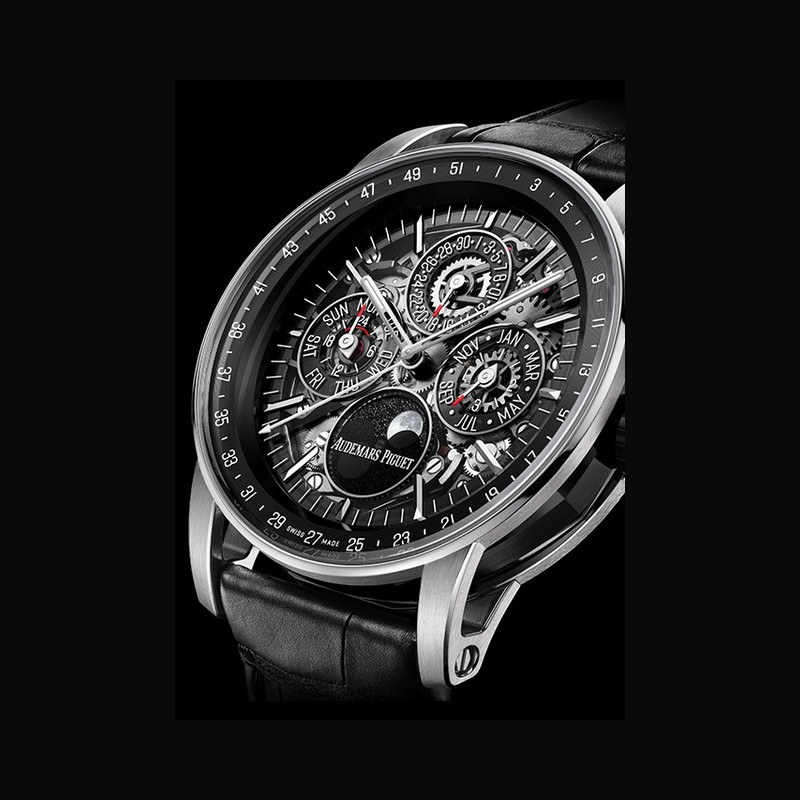
| Brand : | Audemars Piguet |
| Collection : | Code 11.59 |
| Model : | Code 11.59 By Audemars Piguet Selfwinding Perpetual Calendar Openworked |
| Reference : | 26443nb.Oo.D002cr.01 |
| Complement : | White Gold - Strap Alligator |
| On sale : | 2026 |
PDF INDEX CARD


-
Brand : Audemars Piguet Collection : Code 11.59 Model : Code 11.59 By Audemars Piguet Selfwinding Perpetual Calendar Openworked Reference : 26443nb.Oo.D002cr.01 Complement : White Gold - Strap Alligator On sale : 2026 List Price : On request Diameter : 41 mm Thickness : 10.6 mm Styles : High Horology Types : Self-winding Calibre : 7139 Complication : Perpetual calendar with week indication; day; date; astronomical moon; month; leap year; hours and minutes Case material : White gold Case peculiarity : 18-carat white gold bezel Black ceramic case middle Double curved glareproofed sapphire crystal 18-carat white gold and glareproofed sapphire caseback Black ceramic and 18-carat white gold crow Shape : Round Water-resistance : 30 meters Dial : Sapphire Display : Transparent subdials with smoked external zones at 3 9 and 12 o’clock Rhodium-toned pink gold hour-markers White gold hands with luminescent material Black inner bezel Indexes : Baton-type Glass : Sapphire Antireflective coating Strap material : Alligator leather Strap color : Black Strap clasp : Folding buckle + More characteristics :
Movement
Selfwinding Calibre 7139
Total diameter 29.6 mm (12 ¾ lignes)
Total thickness 4.1 mm
Number of parts 423
Number of jewels 41
Minimum power reserve guaranteed 55 h
Frequency of balance wheel 4 Hz (28,800 vibrations/hour)
Case
18-carat white gold
Dial
Sapphire dial
Strap / Buckles
Black square-scale alligator strap with AP folding clasp

DESCRIPTION
A NEW GENERATION OF OPENWORKED PERPETUAL CALENDARS
Le Brassus, February 2026 – Swiss Haute Horlogerie manufacturer Audemars Piguet is delighted to unveil its new in-house selfwinding perpetual calendar openworked movement, Calibre 7139, which offers a modern take on this classic complication and the age-old artistry of openworking. Designed with ergonomics in mind, it incorporates the brand’s intuitive all-in-one crown correction system – introduced last year to celebrate the brand’s 150th anniversary and features a harmonious calendar display that improves legibility. The openworked components let the light shine through to reveal the movement’s mechanical heart. Calibre 7139 debuts on two 41 mm models: a timeless two-tone Code 11.59 by Audemars Piguet – the first openworked perpetual calendar in the collection – and a Royal Oak uniting titanium and Bulk Metallic Glass (BMG). The two timepieces feature sapphire dials that highlight the movement’s minute craftsmanship and refined architecture. Following in the footsteps of the historic Calibre 5135, which was retired last year, Calibre 7139 opens new technical and aesthetic possibilities for this celestial complication.
CALIBRE 7139 SYNCING WITH THE UNIVERSE
Audemars Piguet’s new openworked perpetual calendar movement leverages cutting-edge technology and timeless craftsmanship to enrich user experience and keep life in harmony with the universe’s cyclic rhythms. The perpetual calendar automatically accounts for the varying length of months and leap years, displaying the date and week with flawless precision. Assuming the watch is kept fully wound, the date will only require manual correction in the year 2100 to align with the Gregorian calendar.[1] This celestial complication has shaped Audemars Piguet’s world for over 150 years, inspiring watchmakers to build on ancestral know-how to create advanced timepieces fit for ever-evolving lifestyles.
Calibre 7139 is equipped with the patented crown correction system launched last year with Calibre 7138. Developed by AP engineers to streamline the case design and simplify corrections, this intuitive all-in-one crown is used for the first time with an openworked mechanism. Adjustments to the calendar functions can be made without tools or risk of damage via the crown, which incorporates four positions (1, 2, 3 and 2’) to manage winding, time-setting and all calendar indications with ease.[2] This innovation is driven by a patented, state-of-the-art lever and wandering wheels mechanism that meshes with the various calendar wheels in positions 2 and 2’.[3]
Furthermore, Calibre 7139 draws on the pioneering innovations of Calibre 5133, released in 2018 with the Royal Oak Selfwinding Perpetual Calendar Ultra-Thin RD#2, which combined all calendar functions in one single layer. The end-of-month cam is similarly integrated with the date wheel, while the month cam is fused with the month wheel. Crown corrections form a second layer, enabling the movement to keep a thin 4.1 mm profile. Taking selfwinding Calibre 7120 as its base, the new movement beats at a frequency of 4 Hz (28,800 vph) and provides a minimum power reserve of 55 hours, offering increased performance and robustness.
“Calibre 7139 embodies Audemars Piguet’s firm belief that tradition and innovation must progress hand in hand. Our R&D and complications teams worked closely with our traditional atelier to give life to a perpetual calendar that simplifies corrections and enhances user experience, all while perpetuating the historical art of openworking. This fine craft gives a fascinating insight into the cutting-edge innovation and ancestral expertise at the heart of the movement. It’s been an incredible journey – full of unexpected challenges and learnings.”
Lucas Raggi
Chief Industrial Officer, Audemars Piguet
A CALIBRE PERPETUATING TIME-HONOURED SKILLS
Calibre 7139 provides a new platform for preserving and elevating traditional techniques, including the intricate art of openworking that takes centre stage on the dial and caseback. The main plate, bridges, date wheel, leap year wheel and barrel have been meticulously shaped using electrical discharge machining (EDM). All but the essentials have been stripped back to let the light shine through and reveal the movement’s inner workings. The bridges are hand-finished with elegant V-angles, accounting for over 30 hours of painstaking work per movement. The various components also display refined Haute Horlogerie decorations, such as satin brushing, circular graining, snailing and chamfering. Balancing function and aesthetic refinement, these finishes create striking contrasts and plays of light. Openworking has been an Audemars Piguet specialty since the 1930s. During the Great Depression, AP watchmakers revived this historical art form to occupy their time and hone their skills. This delicate craftsmanship has endured to this day, with each generation of artisans combining time-honoured techniques with creative expression.
Tradition and innovation also converge at the heart of the watch. Calibre 7139 is equipped with a non-magnetic balance spring, which ensures resistance to temperature variations and shocks, as well as optimal chronometric performance. This hairspring is fitted to the balance wheel by hand, using age-old techniques that require great expertise and patience. At Audemars Piguet, this delicate operation is carried out by two highly skilled artisans with over 20 years of experience. This rare craft is typically reserved for movements produced in very small quantities, making Calibre 7139 one of the few production calibres to preserve this know-how today.
Since the 19th century, women have been the main force behind this meticulous task, due to their smaller hands and dexterity. The first balance spring fitting course was opened to women in Geneva in 1843, allowing them to enter the skilled workforce long before they were formally admitted to watchmaking schools. Known as the queens of watchmaking, they played an important role in shaping the industry.
“Traditional balance spring fitting is all about perfection. There is no margin for error. Each hairspring is unique and requires a series of operations that can take several hours of painstaking work to get the heart of the watch beating.”
Nathalie
Balance-spring fitter, Audemars Piguet
A DIAL BRINGING TOGETHER OPENWORKING, ERGONOMICS AND DESIGN HARMONY
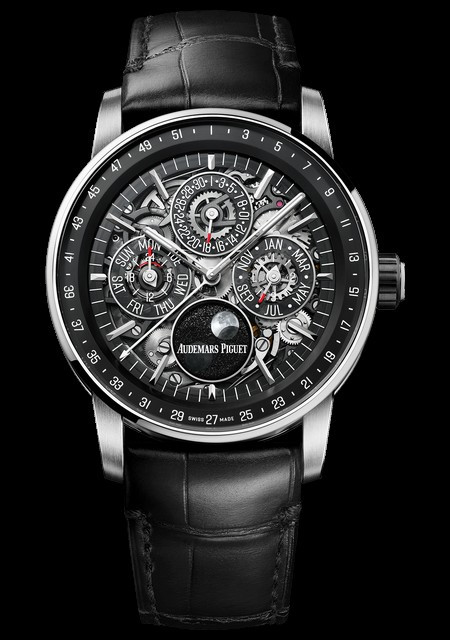
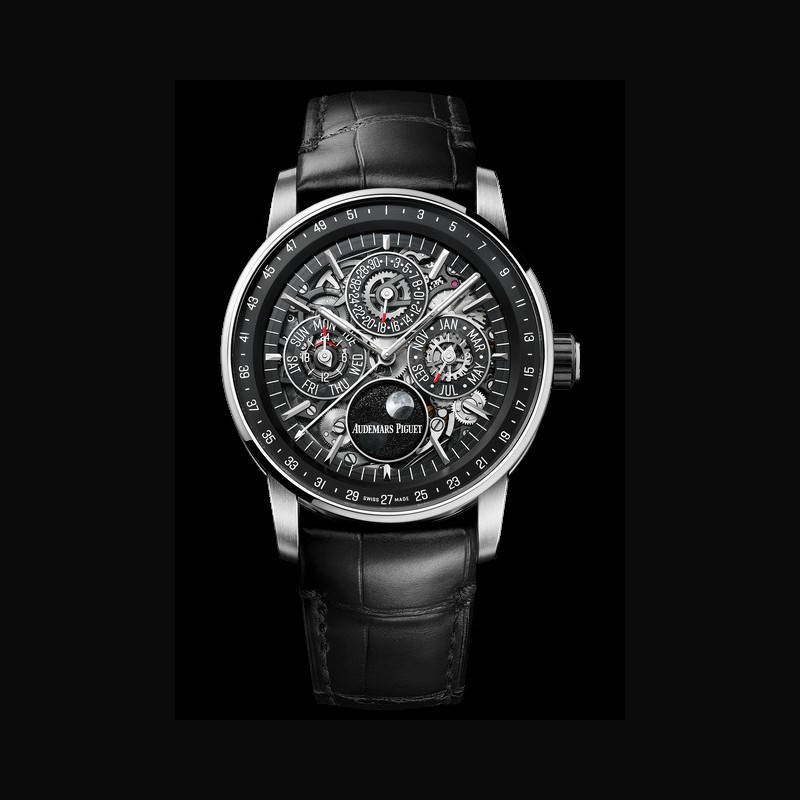
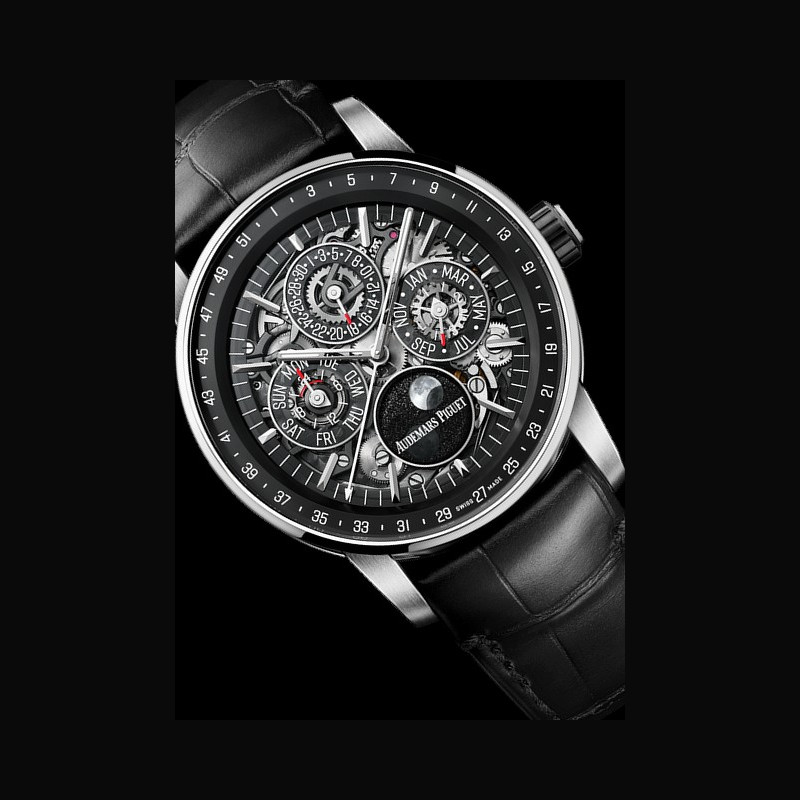
Every detail of Calibre 7139 has been meticulously designed to enhance user experience and legibility, while evoking a sense of symmetry and unity. Its openworked architecture can be admired through the sapphire dial and caseback, which provide views of the movement’s mechanical heart. The calendar indications are rearranged in the European style, with the day at 9 o’clock, the date at noon and the month at 3 o’clock. The week numbers, printed on the inner bezel, now start with the number “1” at 12 o’clock – replacing the previous placement of week “52” in earlier openworked calendar models. In the same logic, “Monday” and “1” are aligned at 12 o’clock in their respective subdial, marking the start of the week and the first day of the month. The dial also features a patented progressive step for the date display at 12 o’clock, operated by a wheel with 31 custom-made teeth of varying sizes adapted to the width of the digits.
To achieve symmetry with the month and leap year at 3 o’clock, a 24-hour indicator has been inserted in the day subdial at 9 o’clock. Additionally, a no-correction zone appears in red between 21h and 3h to underline when the watch should not be set. If the user attempts to adjust the watch during this time, the date may not be corrected. However, there is no risk of damaging the movement in the process. Finally, the keen observer will notice that the full moon in the moon phase subdial at 6 o’clock is now centred on the vertical axis to strengthen the dial’s overall harmony.
A CODE 11.59 BY AUDEMARS PIGUET EMBODYING TIMELESS CRAFTSMANSHIP
Calibre 7139 makes its debut on a 41 mm Code 11.59 by Audemars Piguet, marking a new design and technical milestone for the collection. Its case blends the refinement of 18-carat white gold with the high-tech allure of black ceramic. Placed between a round white gold extra-thin bezel and caseback, the octagonal black ceramic case middle highlights the watch’s multifaceted architecture. All ceramic and gold components have been finished with the Manufacture’s trademark alternation of satin brushing and polished chamfers, creating endless light effects. The finishing on the different components and materials align seamlessly – a meticulous task that can only be performed by highly trained artisans.
The case’s elaborate craftsmanship mirrors the intricacy of the openworked movement it contains, which is showcased through the sapphire dial. A black inner bezel and minute scale open onto the dark and light grey components of Calibre 7139. The dial is complemented with transparent subdials with smoked external zones at 3, 9 and 12 o’clock, revealing the inner beauty and complexity of the movement. At 6 o’clock, the moon phases evolve against a black aventurine backdrop, reminiscent of a starlit sky. Rhodium-toned pink gold hour-markers and 18-carat white gold hands complete the design. The hour and minute hands are coated with luminescent material, while the discreet subdial hands have been developed to maximise legibility, their red tips drawing the eye to the calendar indications.
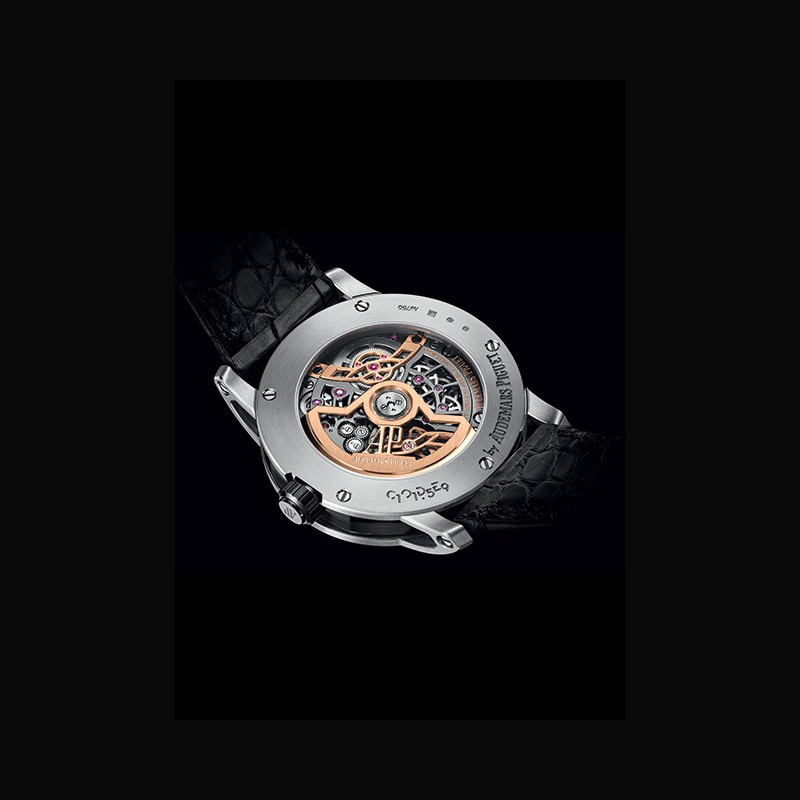
The openworked architecture of Calibre 7139 can also be admired through the sapphire caseback. The pink gold-toned openworked oscillating weight and the matching barrel and balance wheel bridges elegantly contrast with the movement’s grey palette. The watch is mounted on a timeless black alligator strap with square scales and is finished with an 18-carat white gold, triple-blade folding clasp that complements the timepiece’s two-tone design.
SHINING LIGHT ON THE ROYAL OAK’S MECHANICAL HEART
The new 41 mm Royal Oak model unites titanium and precious Bulk Metallic Glass (BMG) for a unique combination of lightness and resistance. First discovered in the 1960s, BMGs are metallic alloys that, when rapidly cooled, take on properties similar to glass, such as high strength and an amorphous structure. Composed of over 50% palladium, Audemars Piguet’s proprietary BMG is highly resistant to wear and corrosion and has a distinctive reflective sheen. The bezel, caseback and bracelet studs are crafted from this precious material and finished with a mirror polish that brings out its natural brilliance. In contrast, the case, crown and bracelet links are honed from titanium and feature the Manufacture’s signature satin finish. This alternation of polishing and satin brushing creates a rich interplay of light, while highlighting the Royal Oak’s complex architecture.
Calibre 7139 takes centre stage on both sides of the watch. Framed by a black inner bezel and minute scale, the sapphire dial discloses the movement’s openworked bridges and wheels, alternating dark and light grey shades. The smoked subdials offer further glimpses of the movement’s mechanical heart. All are delineated by a fine pink gold-toned thread, the bright colour which is echoed by the pink gold hour-markers and hands, coated with luminescent material. The pink gold accents continue on the caseback side. In addition to exhibiting the movement’s architectural design, the sapphire back highlights the openworked oscillating weight, barrel bridge and balance wheel bridge, all of which display a pink gold hue.
Like its Code 11.59 by Audemars Piguet counterpart, the new Royal Oak brings out the seamless blend of tradition and innovation at the heart of Calibre 7139, promising many surprises in the years to come.
“Uniting the art of openworking with ergonomic design, this new movement offers a contemporary take on a classic complication – reaffirming our commitment to crafting timepieces that resonate with modern lifestyles while honouring our heritage.”
Ilaria Resta
Chief Executive Officer, Audemars Piguet
“The Beat Goes On”
[1]The Gregorian calendar omits three leap years every 400 years to keep in sync with solar time. This is achieved by omitting the 29th February in the century years that are divisible by 100, but not by 400. As a result, 2100 will not be a leap year and perpetual calendar mechanisms will have to be moved forward by one day.
[2] The first position winds the watch clockwise. Pulling the crown out one step (position 2) sets the date clockwise and adjusts the month and the leap year in the opposite direction. By pulling the crown out again (position 3), the user can set the time bidirectionally. The 2’ position is reached by pushing the crown back one step to set the day and week clockwise and the moon phases counterclockwise.
[3]The innovation is protected by two patents: one for 2’ position and one for the month and date correction via the crown.
A NEW GENERATION OF OPENWORKED PERPETUAL CALENDARS
Le Brassus, February 2026 – Swiss Haute Horlogerie manufacturer Audemars Piguet is delighted to unveil its new in-house selfwinding perpetual calendar openworked movement, Calibre 7139, which offers a modern take on this classic complication and the age-old artistry of openworking. Designed with ergonomics in mind, it incorporates the brand’s intuitive all-in-one crown correction system – introduced last year to celebrate the brand’s 150th anniversary and features a harmonious calendar display that improves legibility. The openworked components let the light shine through to reveal the movement’s mechanical heart. Calibre 7139 debuts on two 41 mm models: a timeless two-tone Code 11.59 by Audemars Piguet – the first openworked perpetual calendar in the collection – and a Royal Oak uniting titanium and Bulk Metallic Glass (BMG). The two timepieces feature sapphire dials that highlight the movement’s minute craftsmanship and refined architecture. Following in the footsteps of the historic Calibre 5135, which was retired last year, Calibre 7139 opens new technical and aesthetic possibilities for this celestial complication.
CALIBRE 7139 SYNCING WITH THE UNIVERSE
Audemars Piguet’s new openworked perpetual calendar movement leverages cutting-edge technology and timeless craftsmanship to enrich user experience and keep life in harmony with the universe’s cyclic rhythms. The perpetual calendar automatically accounts for the varying length of months and leap years, displaying the date and week with flawless precision. Assuming the watch is kept fully wound, the date will only require manual correction in the year 2100 to align with the Gregorian calendar.[1] This celestial complication has shaped Audemars Piguet’s world for over 150 years, inspiring watchmakers to build on ancestral know-how to create advanced timepieces fit for ever-evolving lifestyles.
Calibre 7139 is equipped with the patented crown correction system launched last year with Calibre 7138. Developed by AP engineers to streamline the case design and simplify corrections, this intuitive all-in-one crown is used for the first time with an openworked mechanism. Adjustments to the calendar functions can be made without tools or risk of damage via the crown, which incorporates four positions (1, 2, 3 and 2’) to manage winding, time-setting and all calendar indications with ease.[2] This innovation is driven by a patented, state-of-the-art lever and wandering wheels mechanism that meshes with the various calendar wheels in positions 2 and 2’.[3]
Furthermore, Calibre 7139 draws on the pioneering innovations of Calibre 5133, released in 2018 with the Royal Oak Selfwinding Perpetual Calendar Ultra-Thin RD#2, which combined all calendar functions in one single layer. The end-of-month cam is similarly integrated with the date wheel, while the month cam is fused with the month wheel. Crown corrections form a second layer, enabling the movement to keep a thin 4.1 mm profile. Taking selfwinding Calibre 7120 as its base, the new movement beats at a frequency of 4 Hz (28,800 vph) and provides a minimum power reserve of 55 hours, offering increased performance and robustness.
“Calibre 7139 embodies Audemars Piguet’s firm belief that tradition and innovation must progress hand in hand. Our R&D and complications teams worked closely with our traditional atelier to give life to a perpetual calendar that simplifies corrections and enhances user experience, all while perpetuating the historical art of openworking. This fine craft gives a fascinating insight into the cutting-edge innovation and ancestral expertise at the heart of the movement. It’s been an incredible journey – full of unexpected challenges and learnings.”
Lucas Raggi
Chief Industrial Officer, Audemars Piguet
A CALIBRE PERPETUATING TIME-HONOURED SKILLS
Calibre 7139 provides a new platform for preserving and elevating traditional techniques, including the intricate art of openworking that takes centre stage on the dial and caseback. The main plate, bridges, date wheel, leap year wheel and barrel have been meticulously shaped using electrical discharge machining (EDM). All but the essentials have been stripped back to let the light shine through and reveal the movement’s inner workings. The bridges are hand-finished with elegant V-angles, accounting for over 30 hours of painstaking work per movement. The various components also display refined Haute Horlogerie decorations, such as satin brushing, circular graining, snailing and chamfering. Balancing function and aesthetic refinement, these finishes create striking contrasts and plays of light. Openworking has been an Audemars Piguet specialty since the 1930s. During the Great Depression, AP watchmakers revived this historical art form to occupy their time and hone their skills. This delicate craftsmanship has endured to this day, with each generation of artisans combining time-honoured techniques with creative expression.
Tradition and innovation also converge at the heart of the watch. Calibre 7139 is equipped with a non-magnetic balance spring, which ensures resistance to temperature variations and shocks, as well as optimal chronometric performance. This hairspring is fitted to the balance wheel by hand, using age-old techniques that require great expertise and patience. At Audemars Piguet, this delicate operation is carried out by two highly skilled artisans with over 20 years of experience. This rare craft is typically reserved for movements produced in very small quantities, making Calibre 7139 one of the few production calibres to preserve this know-how today.
Since the 19th century, women have been the main force behind this meticulous task, due to their smaller hands and dexterity. The first balance spring fitting course was opened to women in Geneva in 1843, allowing them to enter the skilled workforce long before they were formally admitted to watchmaking schools. Known as the queens of watchmaking, they played an important role in shaping the industry.
“Traditional balance spring fitting is all about perfection. There is no margin for error. Each hairspring is unique and requires a series of operations that can take several hours of painstaking work to get the heart of the watch beating.”
Nathalie
Balance-spring fitter, Audemars Piguet
A DIAL BRINGING TOGETHER OPENWORKING, ERGONOMICS AND DESIGN HARMONY
Every detail of Calibre 7139 has been meticulously designed to enhance user experience and legibility, while evoking a sense of symmetry and unity. Its openworked architecture can be admired through the sapphire dial and caseback, which provide views of the movement’s mechanical heart. The calendar indications are rearranged in the European style, with the day at 9 o’clock, the date at noon and the month at 3 o’clock. The week numbers, printed on the inner bezel, now start with the number “1” at 12 o’clock – replacing the previous placement of week “52” in earlier openworked calendar models. In the same logic, “Monday” and “1” are aligned at 12 o’clock in their respective subdial, marking the start of the week and the first day of the month. The dial also features a patented progressive step for the date display at 12 o’clock, operated by a wheel with 31 custom-made teeth of varying sizes adapted to the width of the digits.
To achieve symmetry with the month and leap year at 3 o’clock, a 24-hour indicator has been inserted in the day subdial at 9 o’clock. Additionally, a no-correction zone appears in red between 21h and 3h to underline when the watch should not be set. If the user attempts to adjust the watch during this time, the date may not be corrected. However, there is no risk of damaging the movement in the process. Finally, the keen observer will notice that the full moon in the moon phase subdial at 6 o’clock is now centred on the vertical axis to strengthen the dial’s overall harmony.
A CODE 11.59 BY AUDEMARS PIGUET EMBODYING TIMELESS CRAFTSMANSHIP
Calibre 7139 makes its debut on a 41 mm Code 11.59 by Audemars Piguet, marking a new design and technical milestone for the collection. Its case blends the refinement of 18-carat white gold with the high-tech allure of black ceramic. Placed between a round white gold extra-thin bezel and caseback, the octagonal black ceramic case middle highlights the watch’s multifaceted architecture. All ceramic and gold components have been finished with the Manufacture’s trademark alternation of satin brushing and polished chamfers, creating endless light effects. The finishing on the different components and materials align seamlessly – a meticulous task that can only be performed by highly trained artisans.
The case’s elaborate craftsmanship mirrors the intricacy of the openworked movement it contains, which is showcased through the sapphire dial. A black inner bezel and minute scale open onto the dark and light grey components of Calibre 7139. The dial is complemented with transparent subdials with smoked external zones at 3, 9 and 12 o’clock, revealing the inner beauty and complexity of the movement. At 6 o’clock, the moon phases evolve against a black aventurine backdrop, reminiscent of a starlit sky. Rhodium-toned pink gold hour-markers and 18-carat white gold hands complete the design. The hour and minute hands are coated with luminescent material, while the discreet subdial hands have been developed to maximise legibility, their red tips drawing the eye to the calendar indications.
The openworked architecture of Calibre 7139 can also be admired through the sapphire caseback. The pink gold-toned openworked oscillating weight and the matching barrel and balance wheel bridges elegantly contrast with the movement’s grey palette. The watch is mounted on a timeless black alligator strap with square scales and is finished with an 18-carat white gold, triple-blade folding clasp that complements the timepiece’s two-tone design.
SHINING LIGHT ON THE ROYAL OAK’S MECHANICAL HEART
The new 41 mm Royal Oak model unites titanium and precious Bulk Metallic Glass (BMG) for a unique combination of lightness and resistance. First discovered in the 1960s, BMGs are metallic alloys that, when rapidly cooled, take on properties similar to glass, such as high strength and an amorphous structure. Composed of over 50% palladium, Audemars Piguet’s proprietary BMG is highly resistant to wear and corrosion and has a distinctive reflective sheen. The bezel, caseback and bracelet studs are crafted from this precious material and finished with a mirror polish that brings out its natural brilliance. In contrast, the case, crown and bracelet links are honed from titanium and feature the Manufacture’s signature satin finish. This alternation of polishing and satin brushing creates a rich interplay of light, while highlighting the Royal Oak’s complex architecture.
Calibre 7139 takes centre stage on both sides of the watch. Framed by a black inner bezel and minute scale, the sapphire dial discloses the movement’s openworked bridges and wheels, alternating dark and light grey shades. The smoked subdials offer further glimpses of the movement’s mechanical heart. All are delineated by a fine pink gold-toned thread, the bright colour which is echoed by the pink gold hour-markers and hands, coated with luminescent material. The pink gold accents continue on the caseback side. In addition to exhibiting the movement’s architectural design, the sapphire back highlights the openworked oscillating weight, barrel bridge and balance wheel bridge, all of which display a pink gold hue.
Like its Code 11.59 by Audemars Piguet counterpart, the new Royal Oak brings out the seamless blend of tradition and innovation at the heart of Calibre 7139, promising many surprises in the years to come.
“Uniting the art of openworking with ergonomic design, this new movement offers a contemporary take on a classic complication – reaffirming our commitment to crafting timepieces that resonate with modern lifestyles while honouring our heritage.”
Ilaria Resta
Chief Executive Officer, Audemars Piguet
“The Beat Goes On”
[1]The Gregorian calendar omits three leap years every 400 years to keep in sync with solar time. This is achieved by omitting the 29th February in the century years that are divisible by 100, but not by 400. As a result, 2100 will not be a leap year and perpetual calendar mechanisms will have to be moved forward by one day.
[2] The first position winds the watch clockwise. Pulling the crown out one step (position 2) sets the date clockwise and adjusts the month and the leap year in the opposite direction. By pulling the crown out again (position 3), the user can set the time bidirectionally. The 2’ position is reached by pushing the crown back one step to set the day and week clockwise and the moon phases counterclockwise.
[3]The innovation is protected by two patents: one for 2’ position and one for the month and date correction via the crown.
-
Brand : Audemars Piguet Collection : Code 11.59 Model : Code 11.59 By Audemars Piguet Selfwinding Perpetual Calendar Openworked Reference : 26443nb.Oo.D002cr.01 Complement : White Gold - Strap Alligator On sale : 2026 List Price : On request Diameter : 41 mm Thickness : 10.6 mm Styles : High Horology Types : Self-winding Calibre : 7139 Complication : Perpetual calendar with week indication; day; date; astronomical moon; month; leap year; hours and minutes Case material : White gold Case peculiarity : 18-carat white gold bezel Black ceramic case middle Double curved glareproofed sapphire crystal 18-carat white gold and glareproofed sapphire caseback Black ceramic and 18-carat white gold crow Shape : Round Water-resistance : 30 meters Dial : Sapphire Display : Transparent subdials with smoked external zones at 3 9 and 12 o’clock Rhodium-toned pink gold hour-markers White gold hands with luminescent material Black inner bezel Indexes : Baton-type Glass : Sapphire Antireflective coating Strap material : Alligator leather Strap color : Black Strap clasp : Folding buckle More characteristics :
Movement
Selfwinding Calibre 7139
Total diameter 29.6 mm (12 ¾ lignes)
Total thickness 4.1 mm
Number of parts 423
Number of jewels 41
Minimum power reserve guaranteed 55 h
Frequency of balance wheel 4 Hz (28,800 vibrations/hour)
Case
18-carat white gold
Dial
Sapphire dial
Strap / Buckles
Black square-scale alligator strap with AP folding clasp