
Tradition Tourbillon 7047
704PT/YY/5ZU SL
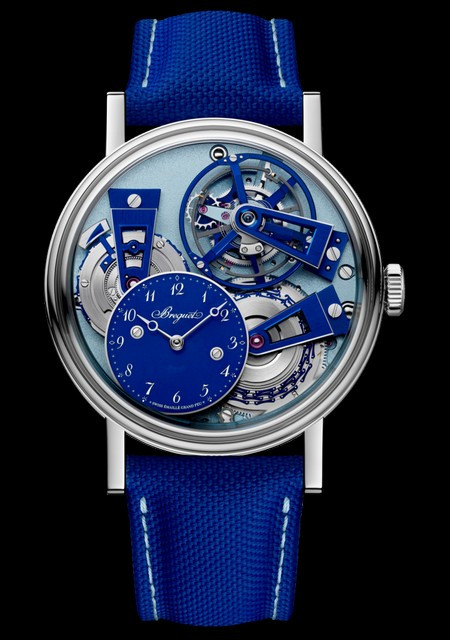
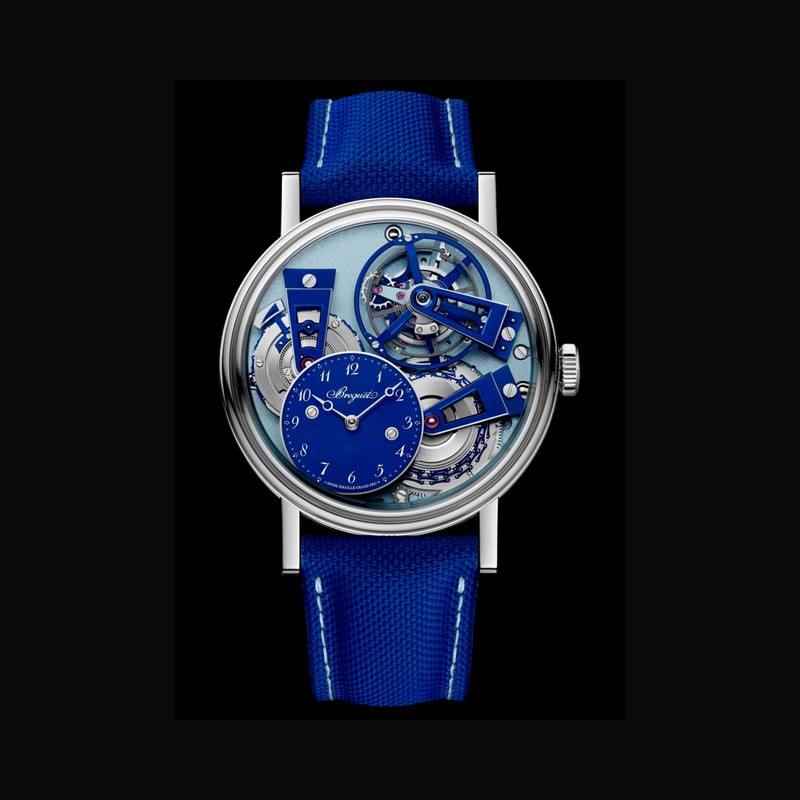
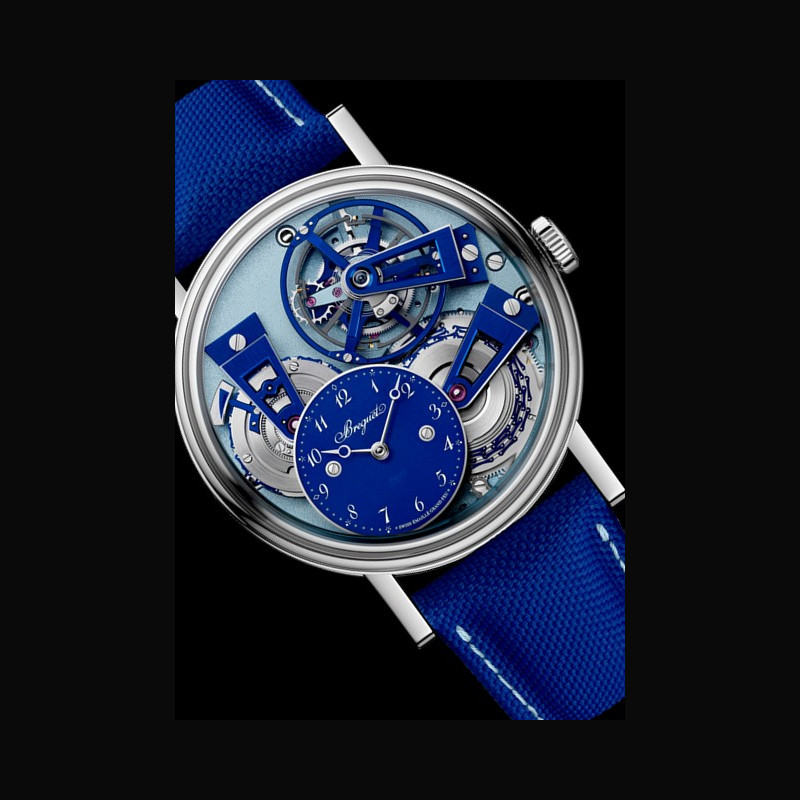
| Brand : | Breguet |
| Collection : | Tradition |
| Model : | Tradition Tourbillon 7047 |
| Reference : | 704PT/YY/5ZU SL |
| Complement : | 950 Platinum - Blue Dial - Strap Rubber |
| On sale : | 2026 |
PDF INDEX CARD


-
Brand : Breguet Collection : Tradition Model : Tradition Tourbillon 7047 Reference : 704PT/YY/5ZU SL Complement : 950 Platinum - Blue Dial - Strap Rubber On sale : 2026 List Price : 288 700 € Diameter : 41 mm Thickness : 16 mm Styles : High Horology Types : Hand-winding Calibre : 569 Calibre distinction : Breguet silicon balance-spring Complication : Hours Minutes and seconds on the Tourbillon cage Power reserve Case material : Platinum Case peculiarity : Fluted case Welded lugs Shape : Round Water-resistance : 30 meters Dial : Grand Feu enamel Dial color : Blue Display : Breguet Arabic numerals Breguet hours and minutes hands in rhodium-plated 18K gold Glass : Sapphire Double Anti-Reflective Strap material : Rubber Strap color : Blue Strap clasp : Folding buckle + More characteristics :
Movement
One-minute Tourbillon with fusee-and-chain transmission
Calibre 569, numbered and signed Breguet
10.8 mm thick
36 mm in diameter, 16 lignes
Manual winding
55-hour power reserve
Frequency 2.5 Hz (18,000 vibrations per hour)
Breguet silicon balance-spring
Glacier blue shotblasted mainplate
Double mainspring
Tourbillon cage in Bleu de France-treated titanium
Blue spinel on the Tourbillon bar
Bleu de France-treated fusee bridge and barre
l Tourbillon bridge in stainless steel treated with Bleu de France
Bleu de France-treated 77-link chain
Chain composed of 232 links, including 77 treated in Bleu de France
499 components
43 jewels
Case
950 platinum
Dial
210-carat palladium gold with Grand Feu Bleu de France enamel
Strap / Buckles
Bleu de France rubber with glacier blue topstitching
Triple-blade folding clasp in 950 platinum
Weight of 950 platinum
~91.9 g
Weight of 18K gold
~2.7 g
Limited edition
25 watches, numbered and hand-engraved from 1/25 to 25/25 on the caseback Warranty
5-year international warranty

DESCRIPTION
1801–2026: 225 years since the invention of the Tourbillon
Breguet celebrates the Tourbillon legacy with a number of exclusive creations
In 2026, Breguet pays tribute to the invention of the Tourbillon, for which Abraham-Louis Breguet was granted his historic patent on 7 Messidor Year 9 according to the French revolutionary calendar, corresponding to 26 June 1801. This means that this eminent complication has been an enduring part of day-to-day life for the Manufacture Breguet, its collectors and the entire watch industry – which has since widely adopted its founding principle – for exactly 225 years.
Since then, the Manufacture has continued to foster the progress of the great watchmaker’s invention, constantly drawing on its original inspiration, while over the decades introducing valuable technical refinements serving a single purpose: the quest for precision. All the new models presented today are part of this vision.
An invention at the heart of history
1793: the turmoil of the French Revolution eventually convinced Breguet to leave his workshop on the Quai de l’Horloge and enjoy a much-needed escape with his family. In Neuchâtel and subsequently in Le Locle, the watchmaker took advantage of this respite to revisit some of his creative visions and contemplate the future of his company.
Upon his return to Paris in 1795, Breguet unveiled a number of inventions that would prove decisive not only for his own future, but also for that of horology as a whole: the sympathique clock (a clock that sets the time of a pocket watch that is placed on top of it), the souscription watch (whose minimalist design redefined the aesthetic codes of watchmaking, and which the House of Breguet reinterpreted in 2025), along with the à tact watch (serving to read the time by touch), among many others.
A.-L. Breguet developed two new mechanisms: firstly, the constant-force escapement, patented in 1798 and secondly, a Tourbillon regulator device patented three years later in 1801. It is the latter that we are now celebrating on its 225th anniversary.
Origins of a watchmaking revolution
The Tourbillon regulator, or Tourbillon, is based on the observation that the oscillation of certain watch components – and more critically the balance and balance-spring – is “pulled” downwards by the force of gravity. The regulation organ’s operation is thus affected, and indeed unevenly so, when the watch is held vertically – which was almost always the case for a pocket watch in Breguet’s day.
To resolve this difficulty, Breguet was naturally aware that he could not defy the laws of gravity. In a sense, he therefore circumvented the problem by inventing a system based around a cage (also known as a cage) in which the escapement and the regulating mechanisms (balance and balance-spring) are enclosed and kept in constant rotation around an axis, in all positions. The balance-and-spring assembly’s centre of gravity is thus continually realigned with the axis of rotation, compensating for the adverse effects of the uneven oscillation of a watch held in a static position. Breguet designed this system to “mix up” all vertical positions and ultimately achieve higher average accuracy.
If we consider that the Tourbillon took shape in Breguet’s mind between 1793 and 1795 (during his stay in Switzerland), six years elapsed between his return to Paris and the granting of the patent on 26 June 1801 – and a further six years would pass between the official approval of this patent and the first sales.
Breguet and his employees went on to produce 40 Tourbillons between 1796 and 1829, along with nine other such timepieces that were never completed and are recorded in the accounts as written off, scrapped or lost.
Since then, the Manufacture has never ceased striving to perfect this mechanism – one of the trickiest and most complex in the realm of Haute Horlogerie – in order to open up new chronometric horizons. With this in mind, the House continues to develop new watchmaking processes (high frequency) and also ventures to explore other disciplines with a view to enriching the Tourbillon with the latest scientific breakthroughs (such as the constant-force magnetic escapement).
Tradition Tourbillon 7047
Upon his return to France following the revolutionary events from which he had taken refuge in Switzerland, A.-L. Breguet developed two new mechanisms. First, an escapement known as the “constant-force” escapement, patented in 1798; secondly the “Tourbillon regulator” process patented three years later in 1801 and that now forms the heart of the new 7047.
A word from Gregory Kissling, CEO of Montres Breguet:
“This edition is probably the most exclusive we have ever created for the Tradition Tourbillon 7047. A platinum case, a Bleu de France dial reserved for exceptional creations, a 25-piece limited edition and a Breguet signature hand-engraved using a pantograph: this is a timepiece for the history books, yet resolutely forward-looking and very different from any of its predecessors as the first and only one to be presented in a version featuring variations on a single colour: blue. This highly daring finish proves the validity of the 7047’s unique design which we conceptualised over 20 years ago, in 2007, and which remains remarkably relevant today.”
An ingenious mechanism for regulating torque: the fusee-and-chain device
To build on the invention of the Tourbillon, the House turned to a principle formalised by another great mind of his time: Leonardo da Vinci. While the latter probably did not invent the fusee-and-chain concept that predates his own (still preserved) sketches by some 50 years, he did explicitly detail its geometry and principles as they are still used in contemporary watchmaking.
In fusee-and-chain transmission, intended to ensure constant torque, the chain unwinds around a cone-shaped element (the fusee) with an inherently decreasing circumference. Thus, when the barrel is fully wound (“armed’” and ready to deliver its maximum force (“torque”’), the chain acts on the top of the fusee and therefore its smallest circumference. The chain’s torque decreases as it unwinds, while at the same time moving toward the widest part of the fusee, its base. These two simultaneously occurring actions cancel each other out, ensuring that the force delivered remains constant.
Tradition Tourbillon 7047: the meeting of two brilliant minds
The Breguet Tradition Tourbillon 7047 unites these two principles and spirits of genius: the Tourbillon patented by Breguet, and the fusee-and-chain mechanism devised by Da Vinci. The Manufacture has now achieved perfect mastery of its dimensions, operation and production. Its fusee-and-chain mechanism boasts unrivalled strength, capable of withstanding a tensile force equivalent to 6 kilograms – although this is, of course, far less during the watch’s normal operation. It thus picks up the work of Abraham-Louis Breguet exactly where he left off in 1795, just over two centuries ago.
An original design for a 25-piece limited edition
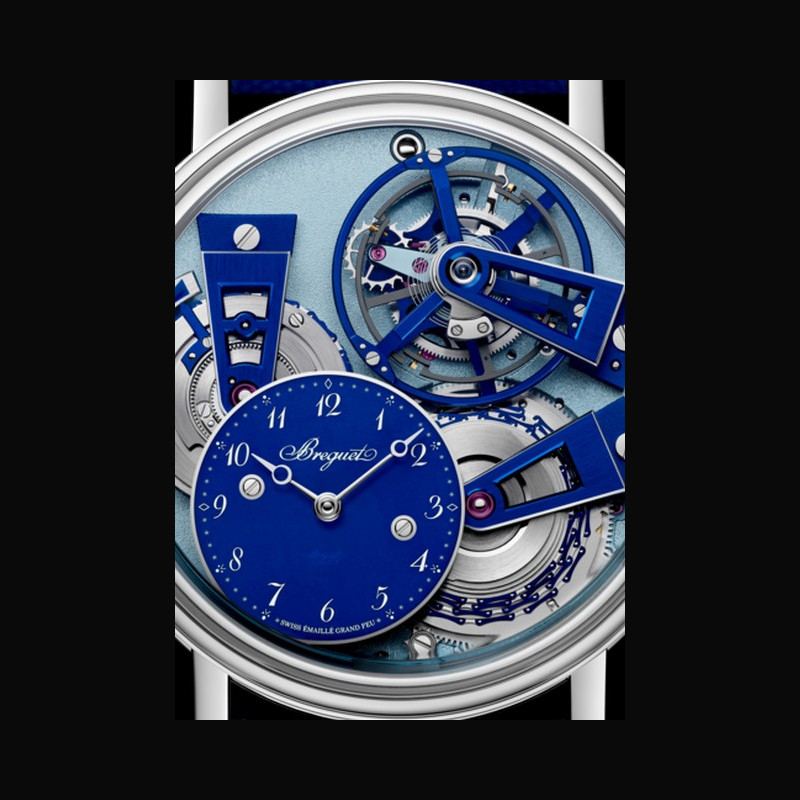
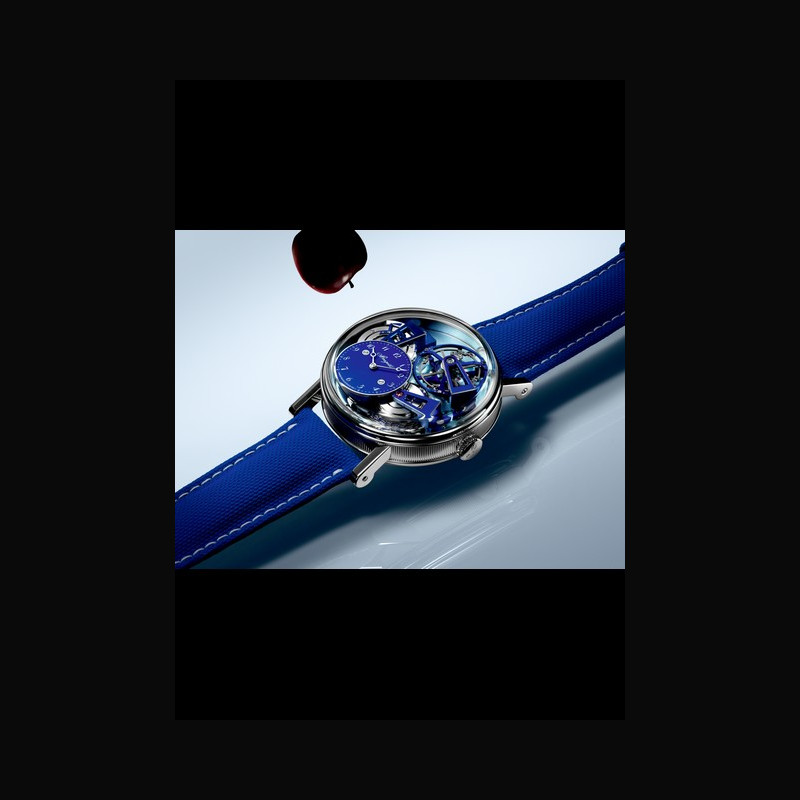
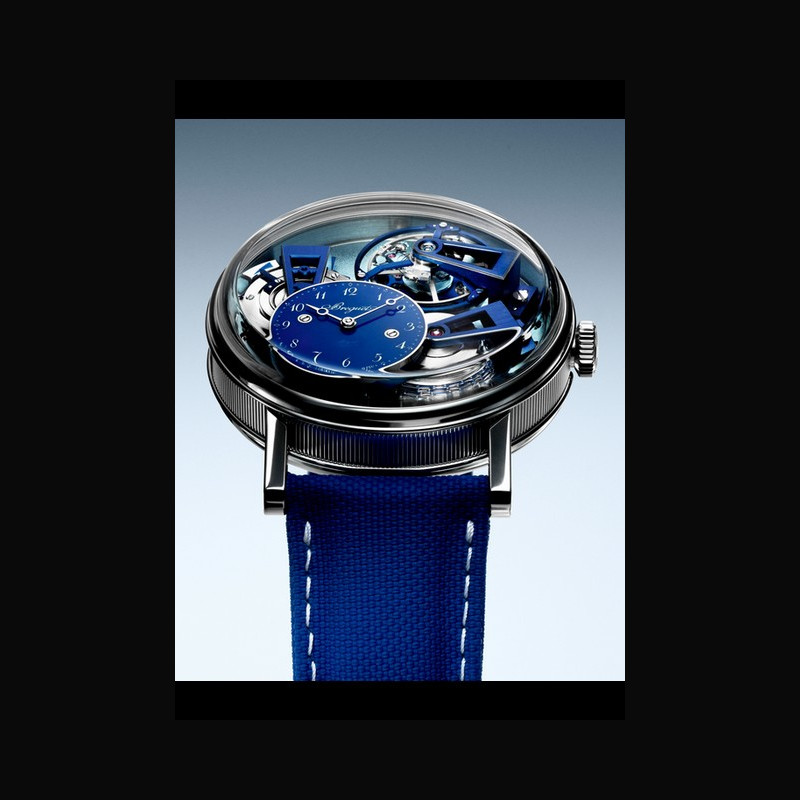
Today, Breguet further explores the aesthetics of the Tradition Tourbillon 7047 with a platinum version adorned in a Bleu de France shade adorning the dial and bridges – not only the Tourbillon bridges, but also the large fusee-and-chain bridge that appears on either side of the time subdial. The fusee-and-chain itself is also finished in Bleu de France.
This shade is an original creation unveiled in 2025 to mark the Manufacture’s 250th anniversary on a Minute Repeater (Classique Répétition Minutes 7365). The Tourbillon cage is fitted with a silicon balance-spring. Since 2010, the cage has been crafted from titanium.
All these elements are finished in the same Bleu de France. Epitomising the extreme attention devoted to details, the traditional ruby-red jewel on the Tourbillon bar has on this occasion been replaced by a blue spinel, to ensure the piece’s chromatic consistency.
For technical reasons relating to the durability of the materials (synthetic ruby vs. spinel), the other traditional jewels have been retained to ensure the perfect functioning of the associated components.
For the first time, the Grand Feu Bleu de France enamel dial features a chapter ring in Arabic numerals. It is on this dial that Breguet’s cherished secret signature appears. As is now customary for the Manufacture’s 250th anniversary, it is hand-engraved using a pantograph.
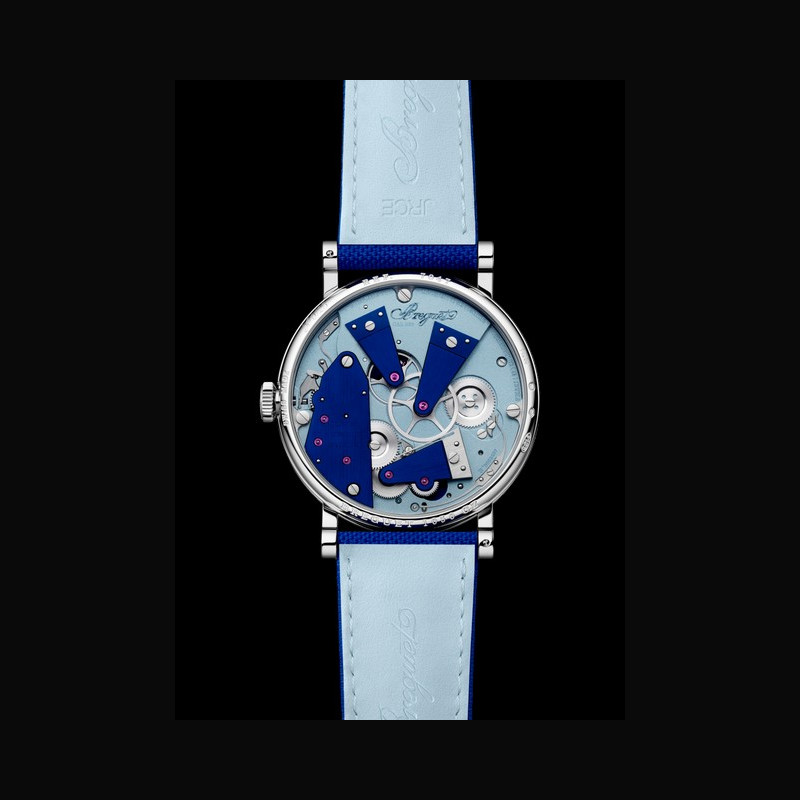
These various elements subtly contrast with a colour never before seen on a Breguet watch: a glacier blue hue adorning the sandblasted mainplate. The same shade is also visible on the caseback, against which the Bleu de France bridges stand out with distinctive clarity, honouring the aesthetic principles of harmony, simplicity and clarity consistently upheld by Abraham-Louis Breguet..
1801–2026: 225 years since the invention of the Tourbillon
Breguet celebrates the Tourbillon legacy with a number of exclusive creations
In 2026, Breguet pays tribute to the invention of the Tourbillon, for which Abraham-Louis Breguet was granted his historic patent on 7 Messidor Year 9 according to the French revolutionary calendar, corresponding to 26 June 1801. This means that this eminent complication has been an enduring part of day-to-day life for the Manufacture Breguet, its collectors and the entire watch industry – which has since widely adopted its founding principle – for exactly 225 years.
Since then, the Manufacture has continued to foster the progress of the great watchmaker’s invention, constantly drawing on its original inspiration, while over the decades introducing valuable technical refinements serving a single purpose: the quest for precision. All the new models presented today are part of this vision.
An invention at the heart of history
1793: the turmoil of the French Revolution eventually convinced Breguet to leave his workshop on the Quai de l’Horloge and enjoy a much-needed escape with his family. In Neuchâtel and subsequently in Le Locle, the watchmaker took advantage of this respite to revisit some of his creative visions and contemplate the future of his company.
Upon his return to Paris in 1795, Breguet unveiled a number of inventions that would prove decisive not only for his own future, but also for that of horology as a whole: the sympathique clock (a clock that sets the time of a pocket watch that is placed on top of it), the souscription watch (whose minimalist design redefined the aesthetic codes of watchmaking, and which the House of Breguet reinterpreted in 2025), along with the à tact watch (serving to read the time by touch), among many others.
A.-L. Breguet developed two new mechanisms: firstly, the constant-force escapement, patented in 1798 and secondly, a Tourbillon regulator device patented three years later in 1801. It is the latter that we are now celebrating on its 225th anniversary.
Origins of a watchmaking revolution
The Tourbillon regulator, or Tourbillon, is based on the observation that the oscillation of certain watch components – and more critically the balance and balance-spring – is “pulled” downwards by the force of gravity. The regulation organ’s operation is thus affected, and indeed unevenly so, when the watch is held vertically – which was almost always the case for a pocket watch in Breguet’s day.
To resolve this difficulty, Breguet was naturally aware that he could not defy the laws of gravity. In a sense, he therefore circumvented the problem by inventing a system based around a cage (also known as a cage) in which the escapement and the regulating mechanisms (balance and balance-spring) are enclosed and kept in constant rotation around an axis, in all positions. The balance-and-spring assembly’s centre of gravity is thus continually realigned with the axis of rotation, compensating for the adverse effects of the uneven oscillation of a watch held in a static position. Breguet designed this system to “mix up” all vertical positions and ultimately achieve higher average accuracy.
If we consider that the Tourbillon took shape in Breguet’s mind between 1793 and 1795 (during his stay in Switzerland), six years elapsed between his return to Paris and the granting of the patent on 26 June 1801 – and a further six years would pass between the official approval of this patent and the first sales.
Breguet and his employees went on to produce 40 Tourbillons between 1796 and 1829, along with nine other such timepieces that were never completed and are recorded in the accounts as written off, scrapped or lost.
Since then, the Manufacture has never ceased striving to perfect this mechanism – one of the trickiest and most complex in the realm of Haute Horlogerie – in order to open up new chronometric horizons. With this in mind, the House continues to develop new watchmaking processes (high frequency) and also ventures to explore other disciplines with a view to enriching the Tourbillon with the latest scientific breakthroughs (such as the constant-force magnetic escapement).
Tradition Tourbillon 7047
Upon his return to France following the revolutionary events from which he had taken refuge in Switzerland, A.-L. Breguet developed two new mechanisms. First, an escapement known as the “constant-force” escapement, patented in 1798; secondly the “Tourbillon regulator” process patented three years later in 1801 and that now forms the heart of the new 7047.
A word from Gregory Kissling, CEO of Montres Breguet:
“This edition is probably the most exclusive we have ever created for the Tradition Tourbillon 7047. A platinum case, a Bleu de France dial reserved for exceptional creations, a 25-piece limited edition and a Breguet signature hand-engraved using a pantograph: this is a timepiece for the history books, yet resolutely forward-looking and very different from any of its predecessors as the first and only one to be presented in a version featuring variations on a single colour: blue. This highly daring finish proves the validity of the 7047’s unique design which we conceptualised over 20 years ago, in 2007, and which remains remarkably relevant today.”
An ingenious mechanism for regulating torque: the fusee-and-chain device
To build on the invention of the Tourbillon, the House turned to a principle formalised by another great mind of his time: Leonardo da Vinci. While the latter probably did not invent the fusee-and-chain concept that predates his own (still preserved) sketches by some 50 years, he did explicitly detail its geometry and principles as they are still used in contemporary watchmaking.
In fusee-and-chain transmission, intended to ensure constant torque, the chain unwinds around a cone-shaped element (the fusee) with an inherently decreasing circumference. Thus, when the barrel is fully wound (“armed’” and ready to deliver its maximum force (“torque”’), the chain acts on the top of the fusee and therefore its smallest circumference. The chain’s torque decreases as it unwinds, while at the same time moving toward the widest part of the fusee, its base. These two simultaneously occurring actions cancel each other out, ensuring that the force delivered remains constant.
Tradition Tourbillon 7047: the meeting of two brilliant minds
The Breguet Tradition Tourbillon 7047 unites these two principles and spirits of genius: the Tourbillon patented by Breguet, and the fusee-and-chain mechanism devised by Da Vinci. The Manufacture has now achieved perfect mastery of its dimensions, operation and production. Its fusee-and-chain mechanism boasts unrivalled strength, capable of withstanding a tensile force equivalent to 6 kilograms – although this is, of course, far less during the watch’s normal operation. It thus picks up the work of Abraham-Louis Breguet exactly where he left off in 1795, just over two centuries ago.
An original design for a 25-piece limited edition
Today, Breguet further explores the aesthetics of the Tradition Tourbillon 7047 with a platinum version adorned in a Bleu de France shade adorning the dial and bridges – not only the Tourbillon bridges, but also the large fusee-and-chain bridge that appears on either side of the time subdial. The fusee-and-chain itself is also finished in Bleu de France.
This shade is an original creation unveiled in 2025 to mark the Manufacture’s 250th anniversary on a Minute Repeater (Classique Répétition Minutes 7365). The Tourbillon cage is fitted with a silicon balance-spring. Since 2010, the cage has been crafted from titanium.
All these elements are finished in the same Bleu de France. Epitomising the extreme attention devoted to details, the traditional ruby-red jewel on the Tourbillon bar has on this occasion been replaced by a blue spinel, to ensure the piece’s chromatic consistency.
For technical reasons relating to the durability of the materials (synthetic ruby vs. spinel), the other traditional jewels have been retained to ensure the perfect functioning of the associated components.
For the first time, the Grand Feu Bleu de France enamel dial features a chapter ring in Arabic numerals. It is on this dial that Breguet’s cherished secret signature appears. As is now customary for the Manufacture’s 250th anniversary, it is hand-engraved using a pantograph.
These various elements subtly contrast with a colour never before seen on a Breguet watch: a glacier blue hue adorning the sandblasted mainplate. The same shade is also visible on the caseback, against which the Bleu de France bridges stand out with distinctive clarity, honouring the aesthetic principles of harmony, simplicity and clarity consistently upheld by Abraham-Louis Breguet..
-
Brand : Breguet Collection : Tradition Model : Tradition Tourbillon 7047 Reference : 704PT/YY/5ZU SL Complement : 950 Platinum - Blue Dial - Strap Rubber On sale : 2026 List Price : 288 700 € Diameter : 41 mm Thickness : 16 mm Styles : High Horology Types : Hand-winding Calibre : 569 Calibre distinction : Breguet silicon balance-spring Complication : Hours Minutes and seconds on the Tourbillon cage Power reserve Case material : Platinum Case peculiarity : Fluted case Welded lugs Shape : Round Water-resistance : 30 meters Dial : Grand Feu enamel Dial color : Blue Display : Breguet Arabic numerals Breguet hours and minutes hands in rhodium-plated 18K gold Glass : Sapphire Double Anti-Reflective Strap material : Rubber Strap color : Blue Strap clasp : Folding buckle More characteristics :
Movement
One-minute Tourbillon with fusee-and-chain transmission
Calibre 569, numbered and signed Breguet
10.8 mm thick
36 mm in diameter, 16 lignes
Manual winding
55-hour power reserve
Frequency 2.5 Hz (18,000 vibrations per hour)
Breguet silicon balance-spring
Glacier blue shotblasted mainplate
Double mainspring
Tourbillon cage in Bleu de France-treated titanium
Blue spinel on the Tourbillon bar
Bleu de France-treated fusee bridge and barre
l Tourbillon bridge in stainless steel treated with Bleu de France
Bleu de France-treated 77-link chain
Chain composed of 232 links, including 77 treated in Bleu de France
499 components
43 jewels
Case
950 platinum
Dial
210-carat palladium gold with Grand Feu Bleu de France enamel
Strap / Buckles
Bleu de France rubber with glacier blue topstitching
Triple-blade folding clasp in 950 platinum
Weight of 950 platinum
~91.9 g
Weight of 18K gold
~2.7 g
Limited edition
25 watches, numbered and hand-engraved from 1/25 to 25/25 on the caseback Warranty
5-year international warranty