Constellation Observatory: Omega sets up new certification standards
In a field where precision is traditionally measured down to the second, Omega sets a major milestone. The house just unveiled the Constellation Observatory collection – the first two-hand watch collection to ever be certified Master Chronometer. This was made possible thanks to a new innovation developed by the Laboratoire de Précision and validated by METAS.

Who still needs a seconds hand?
Until now, chronometric certification processes were based on the observation of the seconds hand – a key element to measure the movement’s regularity. This constraint is now past tense, thanks to a new ground-breaking technology: a process that combines acoustic testing with optical monitoring of the hands.

Developed by the Laboratoire de Précision, an organism officially authorized by the SAS (Swiss Accreditation Service) to conduct independent testing similar to those carried out by the COSC (Official Swiss Chronometer Testing Institute) and certified by METAS (Federal Institute of Metrology), this process allows to continuously analyze the tick-tock sound of the movement for the 22 days of testing required by the Chronometer and Master Chronometer protocols – either 15 days for the former or 8 days for the latter, plus 2 days of evaluation and recalibrating. While classic methods consist of a daily measurement, the Dual Metric Technology receives an infinity of data from the very first second.

About the Laboratoire de Précision
This new structure validated by the Swiss Accreditation Service (SAS) stands as an official alternative to the COSC for performing chronometers certifications. Even though it was created by Omega, this laboratory is independent, neutral and open to any watchmaking company or manufacturer, thus ensuring reliable and unbiased testing meeting the ISO 3159 norm.
Equipped with cutting-edge technologies, the Laboratoire de Précision carries continuous chronometric measurements during 15 days (for the Chronometer test procedures) and 8 days (for the Master Chronometer ones). Conversely, traditional methods are limited to daily measurements. Every vibration is analysed with tenfold increased precision under different conditions such as position and temperature variations. This approach provides for a considerable amount of data that are then exploited according to industrial methods – offering a thorough understanding of the watches’ performances.
This laboratory represents a strategic innovation lever for Omega, especially with the Spirate™ system, as it helps facilitating the constant improvement of their calibres. It also allows the house to integrate more tests to their production line – with Swatch Group’s in-house expertise. Split between 2 Swiss sites (Bienne and Villeret), the Laboratoire de Précision is the embodiment of a new milestone along the road to watchmaking excellence and precision.

The acoustic signature of a movement reveals in details any frequency variation, environmental sensitivity – temperature, atmospheric pressure, magnetic fields – or amplitude gap. What’s more, it can precisely locate the origin and the time of such irregularities, thus offering an unprecedented analysis tool for watchmakers. More than a simple technical performance, this innovation redefines certification standards. Having a seconds hand has now become optional for precision testing, as Omega’s CEO Raynald Aeschlimann stated.
“Until now, precision certification has required a seconds hand. The development of a new acoustic testing methodology has made that requirement obsolete. It is this breakthrough that has enabled us to present the Constellation Observatory, the first two-hand watch to achieve Master Chronometer certification.”
Raynald Aeschlimann, President and CEO of Omega.

Constellation Observatory: Modernizing heritages
Launched in 1952, the Constellation collection has always embodied Omega’s chronometric strict requirements. With this new Constellation Observatory, the house revives this heritage through nine 39.4mm references that combine historical design and modern innovations.

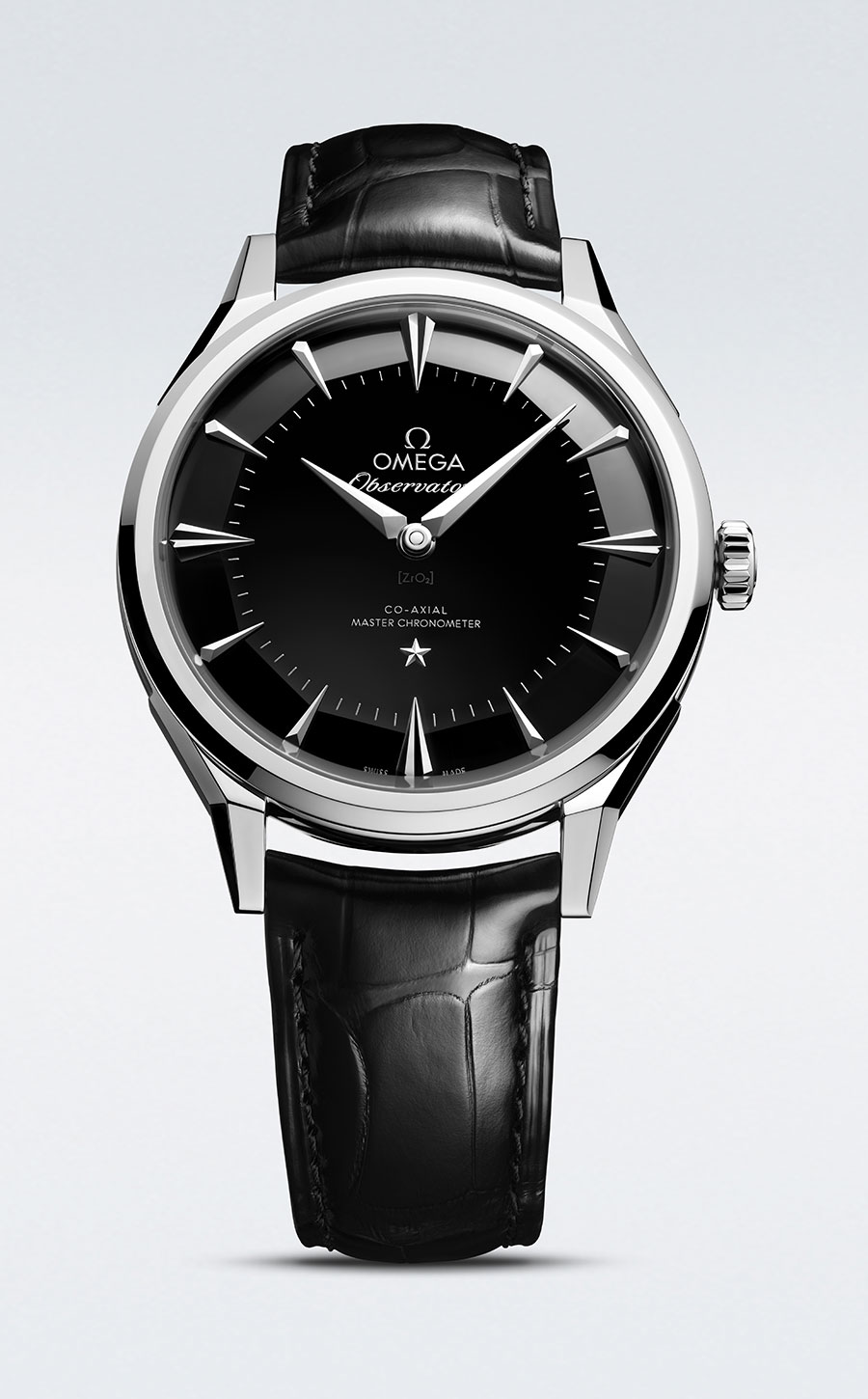
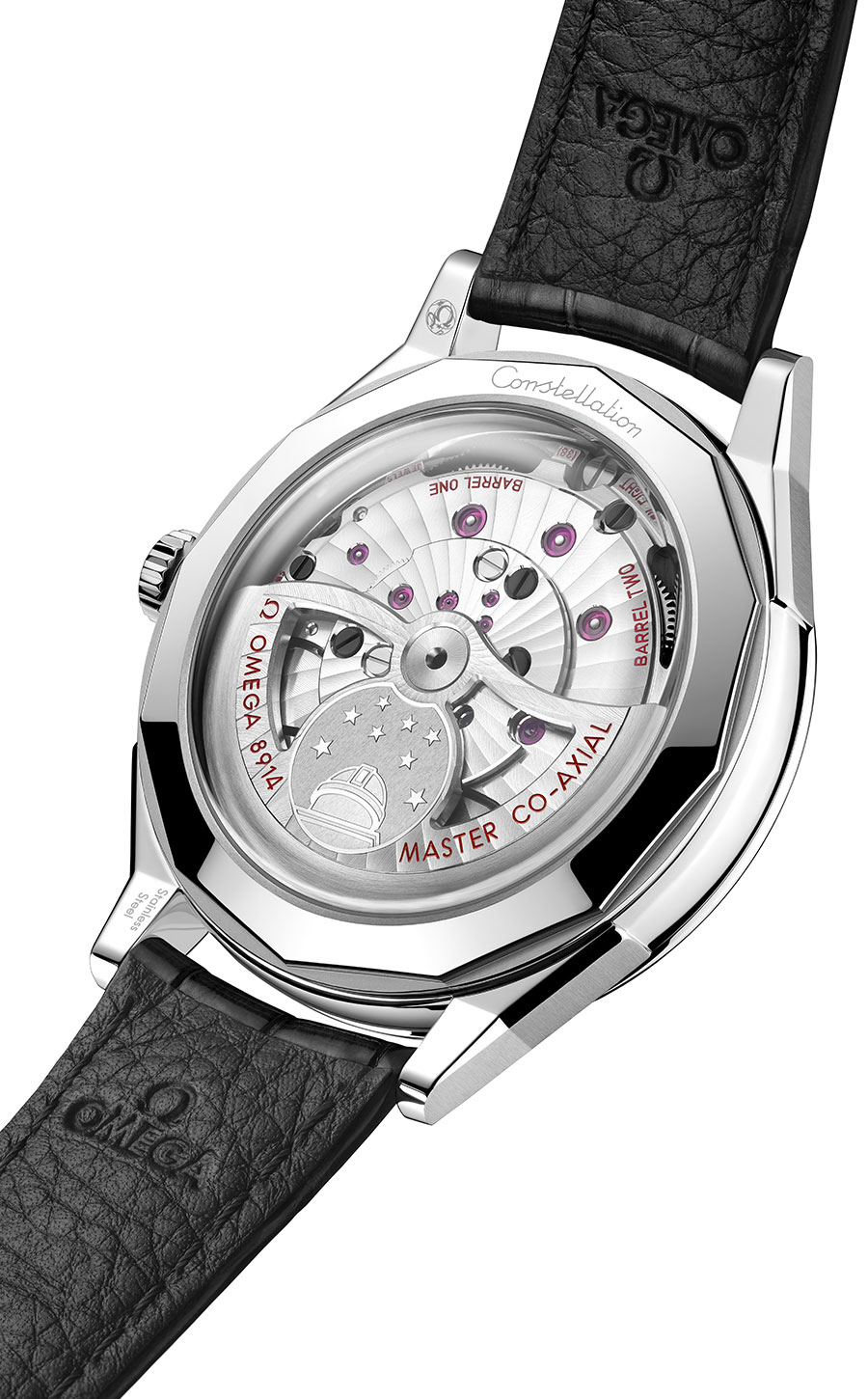
The emblematic aesthetic codes of the historical models are reinterpreted with precision: a twelve-sided pie pan dial with facets either stamped or hand-guilloche for the Grand Luxe variations, a star at 6 o’clock, dauphine hands and faceted kite-form indices. On the case back, the eight stars that circle the Observatory medallion symbolize the house’s victories in official watch precision contests organized by prestigious observatories such as Geneva’s. The dog-leg lugs and the 9-link brick pattern 18K Moonshine™ mesh bracelet also deserve full attention.
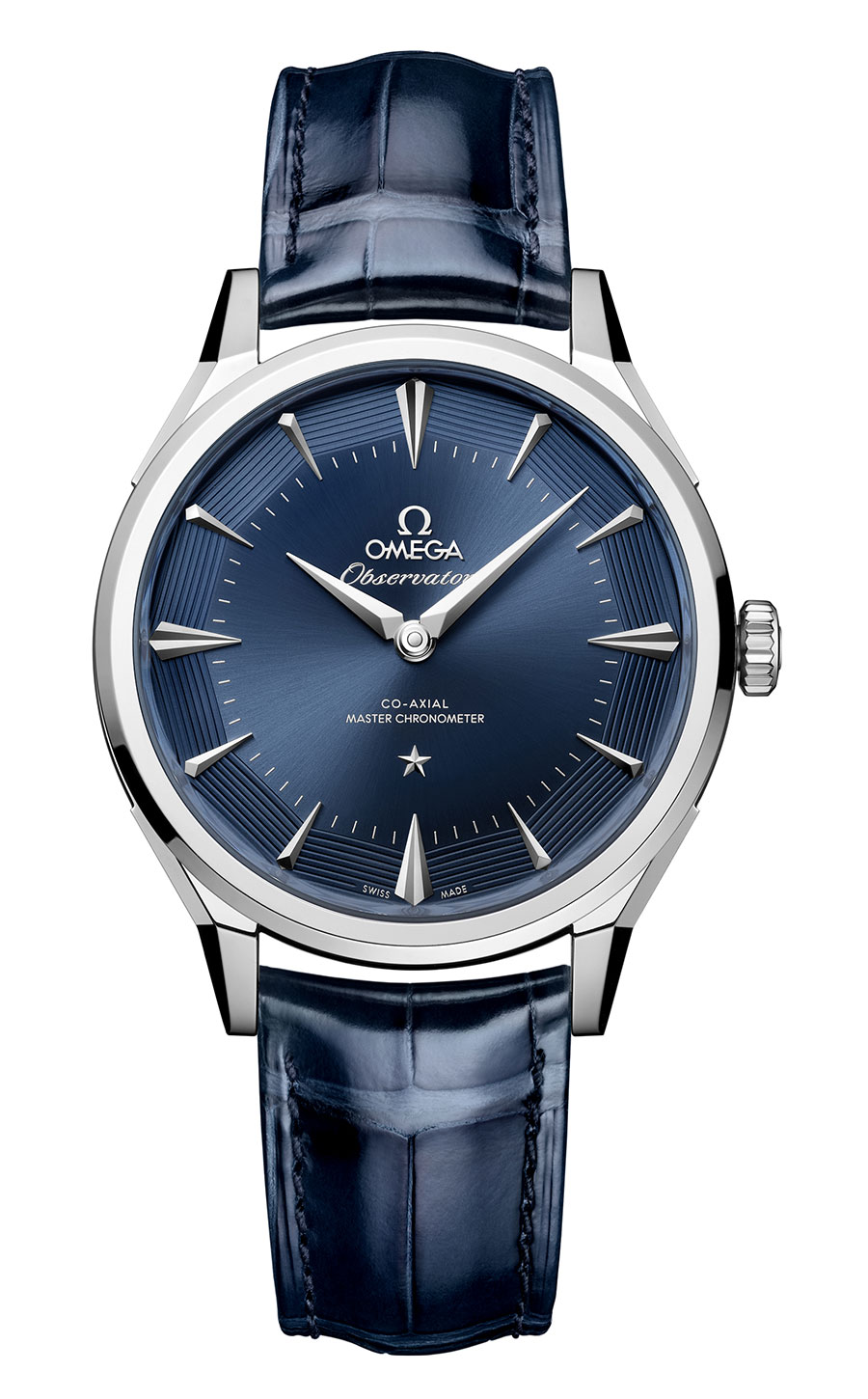
Such accurate aesthetics come with acutely sophisticated materials and finishing, especially with the arrival of guilloche and black ceramic dials, or the use of exclusive alloys such as O-MEGASTEEL, Moonshine™ or Sedna™ gold, etc.

New calibres and upmarket technical improvements
The collection introduces two new Master Chronometer movements: calibres 8914 and 8915. They both rely on an architecture with a pierced rotor and enriched top-of-the-range finishing as well as a distinctive Observatory medallion. Calibre 8915 is also available as Grand Luxe and Luxe editions, integrating precious materials like Moonshine™ or Sedna™ gold. Resisting magnetic waves up to 15,000 gauss, the automatic bi-directional movements offer a power reserve of about 60 hours.


The models made out of 18K Sedna™ gold and 18k Canopus Gold™ feature an angulous case and a transparent case back that reveals a movement decorated with 18K Sedna™ gold.
The Platinum-Gold edition stands out by its thorough decoration level. The pie pan dial is dressed in a Platinum 950 gold PVD coating.

Delivered in a special marquetry box, this exceptional edition is powered by the Calibre 8915 by Omega with a pierced 18K Sedna™ gold rotor adorned by an 18K white gold medallion. This precious emblem shows the observatory, engraved with a laser then enameled, with a starry background made of dark blue aventurine.

Every O-MEGASTEEL model is equipped with Calibre 8914 and a rhodium-plated rotor – thus following the same technical requirements for a more affordable price.
With this new Constellation Observatory, Omega doesn’t just launch a new collection: they redefine the very foundations of watchmaking precision measurements. By setting the certification process free from the obstacle the seconds hand represented, they pave the way for new timepieces to get certified. An innovation that could eventually spread to the whole industry.
Such precision wasn’t born yesterday
1948: Omega unveils their first self-winding wristwatch ever certified Chronometer: the Centenary.
1952: the Constellation is launched as Omega’s first mass-produced chronometers collection. Ever since the beginning, every mechanical Constellation model has been a chronometer.
1999-2013: Omega introduces the Co-Axial escapement that reduces fiction for a durable precision – their first practical innovation in 250 years. It is quickly followed by anti-magnetic movements that feature anti-magnetic components as well as NivaGauss™ silicon.
2015: the Globemaster becomes the first watch certified Master Chronometer by METAS. The final watches are tested on their precision scores, their magnetic resistance, their power reserve and their waterproofness.
2023: Omega establishes the Laboratoire de Précision – officially accredited as a testing laboratory according to the ISO/IEC 17025 :2017 norm.
2026: the Constellation Observatory becomes the first two-hand watch to be certified Master Chronometer through an acoustic process – that doesn’t require any seconds hand for precision testing – performed by the Laboratoire de Précision.

Constellation Observatory – Ref. 14013392101001 – O-MEGASTEEL – Black dial – Black leather strap – €11,900
Constellation Observatory – Ref. 14013392102001 – O-MEGASTEEL – Silver dial – Black leather strap – €10,700
Constellation Observatory – Ref. 14013392103001 – O-MEGASTEEL – Blue dial – Blue leather strap – €10,700
Constellation Observatory – Ref. 14013392110001 – O-MEGASTEEL – Green dial – Green leather strap – €10,700
Constellation Observatory – Ref. 14050392199001 – Moonshine™ Gold – Yellow dial – Bracelet Moonshine™ Gold – €57,700
Constellation Observatory – Ref. 14053392199001 – Moonshine™ Gold – Yellow dial – Green leather strap – €37,000
Constellation Observatory – Ref. 14053392199002 – Sedna™ Gold – Pink dial – Burgundy leather strap – €37,000
Constellation Observatory – Ref. 14053392199004 – Canopus Gold™ – Silver dial – Navy blue leather strap – €43,000
Constellation Observatory – Ref. 14093392199001 – Platinum-Gold – Yellow dial – Black and golden leather strap – €56,400
See also:
Read also: