The Royal Flush of Perpetual Calendars
The perpetual calendar is one of the most breathtaking complications in the watchmaking world. It winds itself up to display the day, date, month, leap years and moon phases — all while accounting for the oddities of the Gregorian calendar — it is equally notorious for… Being a nightmare to set. With correctors embedded in the case band, bespoke tools, and delicate handling required, setting a perpetual calendar was, for a long time, practically a ritual. Today, however, several watchmakers are looking to make the whole process more straightforward. Here are some examples.
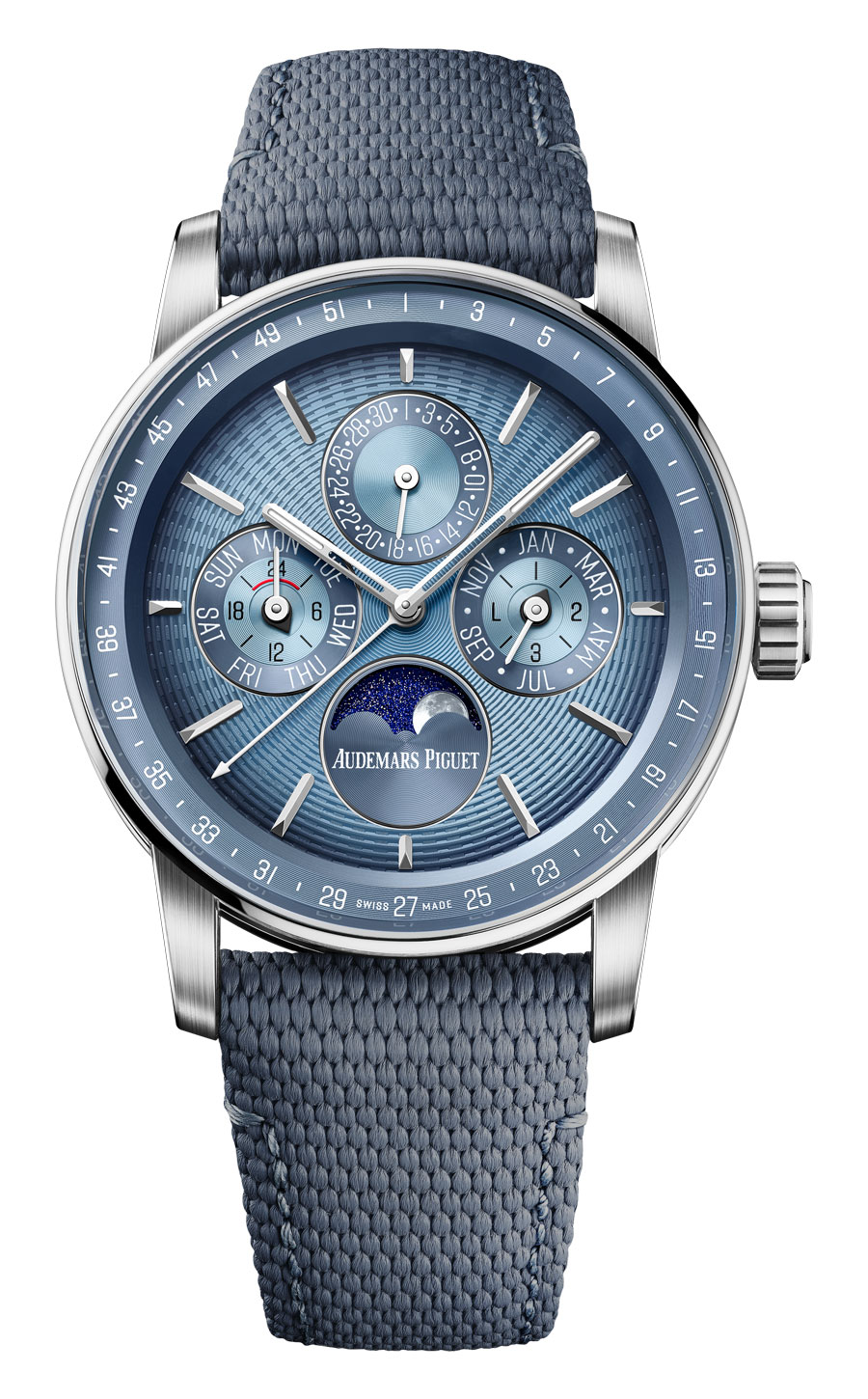
AUDEMARS PIGUET, Code 11.59 by Audemars Piguet self-winding Perpetual Calendar: high complication, smoother look
For its 150th anniversary last year, Audemars Piguet wanted to solve the exact issue mentioned above. It is the main talking point when it comes to perpetual calendars. The upgrade here isn’t just the new Code 11.59 Perpetual Calendar itself. It is actually the self-winding calibre 7138. After being engineered during 5 years and receiving 5 patents, the manufacture has reimagined thoroughly the ergonomics of this complication. This project relied on both a simple and ambitious aim: allowing the wearer to adjust every function, using the crown only.
Managing everything just with the crown
No more case-side correctors, but a 4-position crown instead. Depending on its position and the way it is turned, you can sequentially set the date, month, leap year, day, week number, moon phase, and time. Your daily wear becomes smoother, and the risk of desynchronising the calendar or damaging the movement because of a stray adjustment is starkly lowered. This setup also gives a cleaner feel to the 41mm white gold case. Without case-side correctors, the Code 11.59 features a much refined look. Furthermore, it is water-resistant to 30 metres.

Enhanced legibility
Upgrading movement’s ergonomics was only the first step for the manufacture. Indeed, the dial has also been revamped for enhanced legibility. The displays now follow a more intuitive order, with the day at 9 o’clock, the date at 12 o’clock, and the month at 3 o’clock. A 24-hour display, part of the day sub-dial highlights the 9 pm to 3 am window in red. It shows the period during which the self-winding calendar change occurs. Besides, the moon phase takes up a perfectly centered position at 6 o’clock.
A technical showcase above all
Beneath the sapphire case back lies the calibre 7138. Measuring a mere 4.1mm thick, even with 422 components, it beats at a frequency of 4 Hz, for roughly a 50-hour power reserve. A worthy successor to the developments spearheaded on the Royal Oak RD#2, the movement highlights a design which displays all calendar functions onto a single level to preserve an exceptionally slim profile.

The ‘single-crown’ system
– Position 1: Winding the timepiece clockwise.
– Position 2: Pulling the crown out by one notch allows for clockwise date adjustment, alongside anti-clockwise adjustment of both the month and leap year.
– Position 3: Pulling the crown out once more allows the time to be set in either direction.
– Position 4: Pushing the crown back in by one notch allows for clockwise correction of the day and week, and moon-phase adjustment in the opposite direction.
The smoked, embossed blue dial — crafted from a hand-engraved motif by Yann von Kaenel — brings the hallmark aesthetic touch of the Code 11.59. Yet, its essence lies elsewhere. With this new perpetual calendar, Audemars Piguet isn’t aiming to craft a more stunning complication, but just a smoother one for everyday wear.
€108,900
Click here for the spec sheet of the Self-winding Perpetual Calendar Code 11.59 by Audemars Piguet.
BVLGARI, Octo Finissimo Perpetual Calendar: a record-breaker becomes a classic
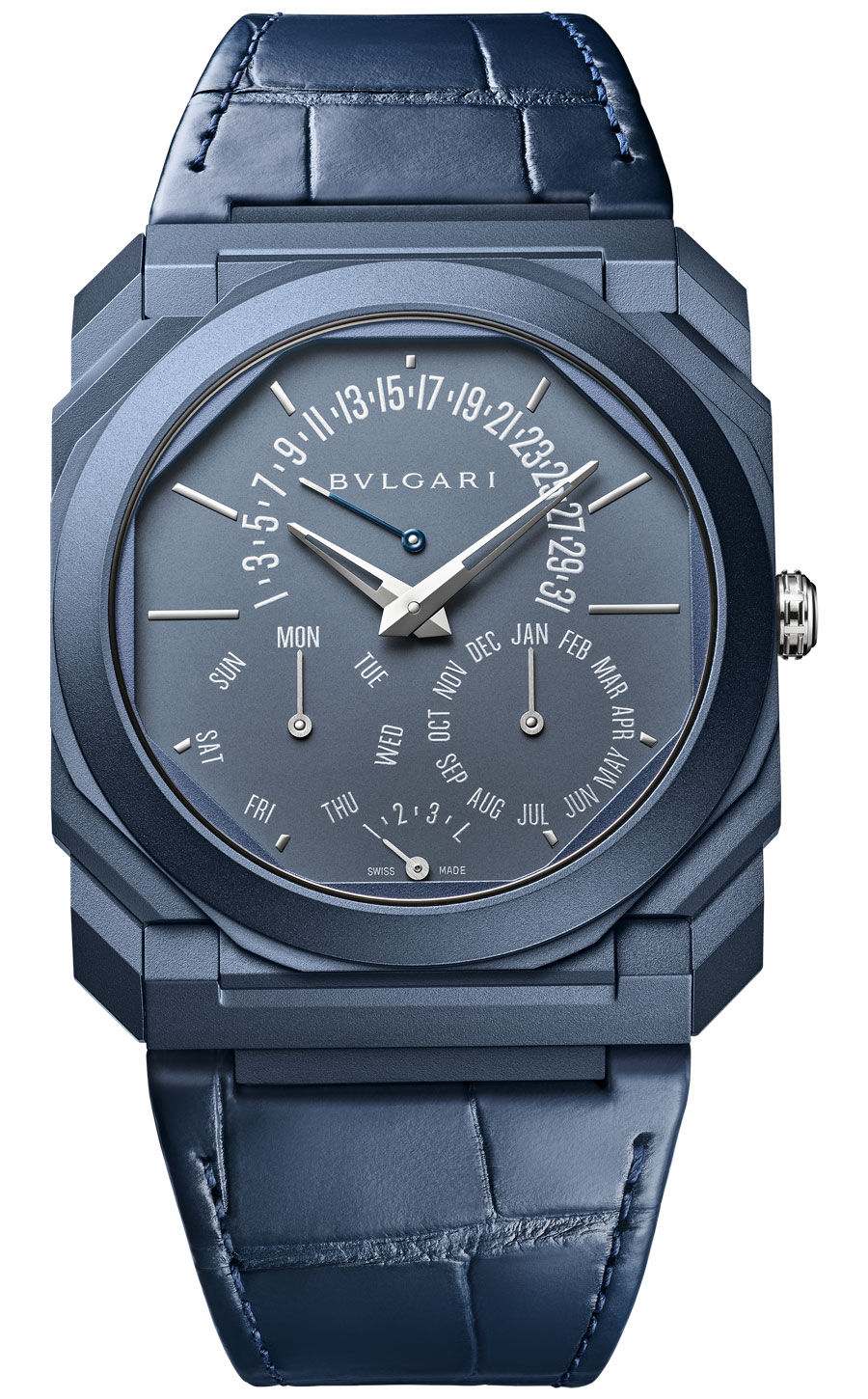
For years, every new Octo Finissimo showcased a world record under its belt. From tourbillons and minute repeaters to GMT chronographs and perpetual calendars, Bvlgari mastered thoroughly ultra-thin watchmaking. But once the records are reached, it raises the question: how to upgrade a timepiece that has already proven exactly what it is capable of? This new Octo Finissimo Perpetual Calendar offers a straightforward answer. Rather than pushing the boundaries of thinness once again, Bvlgari has chosen to explore those of design. Following the titanium iteration — which scooped the prestigious Aiguille d’Or at the Grand Prix d’Horlogerie de Genève in 2021 — as well as gold and carbon iterations, the perpetual calendar now adopts a blue PVD-treated titanium finish for the very first time.
The Octo Finissimo’s 10 World Records
2014 – OCTO FINISSIMO TOURBILLON HAND-WOUND – 1st world record – BVL 268 – 1.95mm
2016 – OCTO FINISSIMO MINUTE REPEATER – 2nd world record –BVL 362 – 3.12mm
2017 – OCTO FINISSIMO SELF-WINDING – 3rd world record – BVL 138 – 2.23mm
2018 – OCTO FINISSIMO SELF-WINDING TOURBILLON – 4th world record – BVL 288 – 1.95mm
2019 – OCTO FINISSIMO SELF-WINDING CHRONOGRAPH GMT – 5th world record – BVL 318 – 3.30mm
2020 – OCTO FINISSIMO SELF-WINDING TOURBILLON CHRONOGRAPH SKELETON – 6th world record – BVL 388 – 3.50mm
2021 – OCTO FINISSIMO PERPETUAL CALENDAR – 7th world record – BVL 305 – 2.75mm – Aiguille d’Or Prize 2021
2022 – OCTO FINISSIMO ULTRA – 8th world record – BVL 180 – 1.80mm
2024 – OCTO FINISSIMO ULTRA COSC – 9th world record – BVL 180 – 1.70mm
2025 – OCTO FINISSIMO ULTRA TOURBILLON – 10th world record – BVF 900 – 1.85mm

Masterful complication, understated look
It is a far subtler design than it appears. The perpetual calendar highlights a vast amount of information: a retrograde date, day, month, leap year, hours, and minutes. Yet, the dial remains remarkably clean and legible. The rhodium-plated hands and silvered hour markers stand out naturally against the lacquered blue backdrop, while the matching case and alligator strap extend this monochrome aesthetic without ever compromising legibility. Titanium plays a major part in this identity. Its lightness enhances the slenderness feel which is the hallmark of Octo Finissimo since its inception.
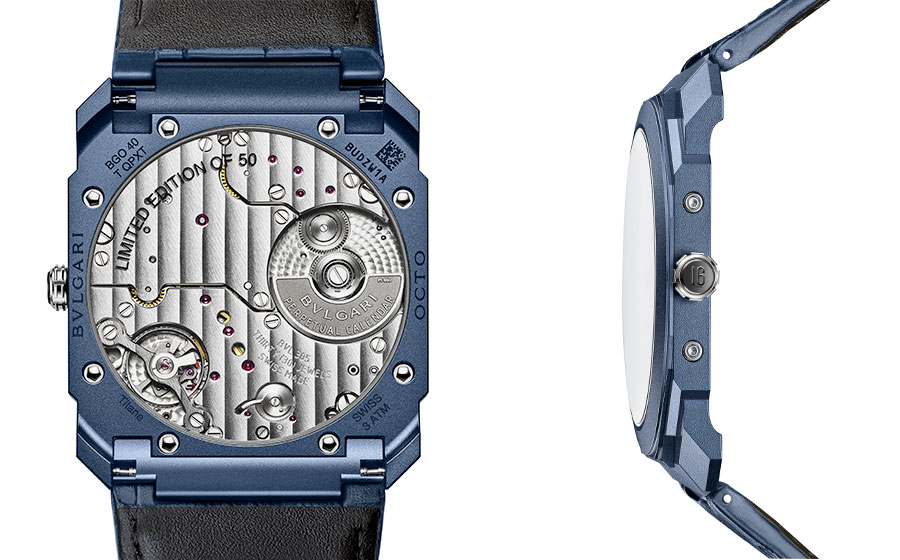
Beneath this new design lies a movement that is as compelling as ever. The manufacture calibre BVL 305 is a mere 2.75mm thick, housed within a 40mm case. Despite this remarkably compact architecture, it delivers a full perpetual calendar display with a retrograde date, while boasting a 60-hour power reserve.
€76,000
Technical Specifications:
Ultra-thin, in-house BVL 305 self-winding mechanical movement (2.75 mm thick)
Functions: Hours, minutes, perpetual calendar, retrograde date, day, month, and leap year
Roughly 60-hour power reserve
Frequency: 21,600 vibrations per hour (3 Hz)
40mm extra-thin sandblasted titanium case with a blue PVD coating (5.8mm thick)
Polished steel crown with a black ceramic insert
See-through case back
Water-resistant to 30 metres
Blue alligator leather strap with a polished titanium pin buckle
Blue lacquered dial with grey rhodium-plated hands and silvered hour markers
IWC Big Pilot’s Perpetual Calendar ProSet Edition “Le Petit Prince”: now adjustable both ways
The perpetual calendar is one of watchmaking’s finest complications — but, as we all know, it is also far from easy to handle. Back in 1985, IWC made waves with Kurt Klaus’s ingenious system, which allowed all indicators to be set easily thanks to the crown. Four decades on, the manufacture is going the extra mile with the IWC-ProSet® Perpetual Calendar, a complete revamp of the timepiece settings.
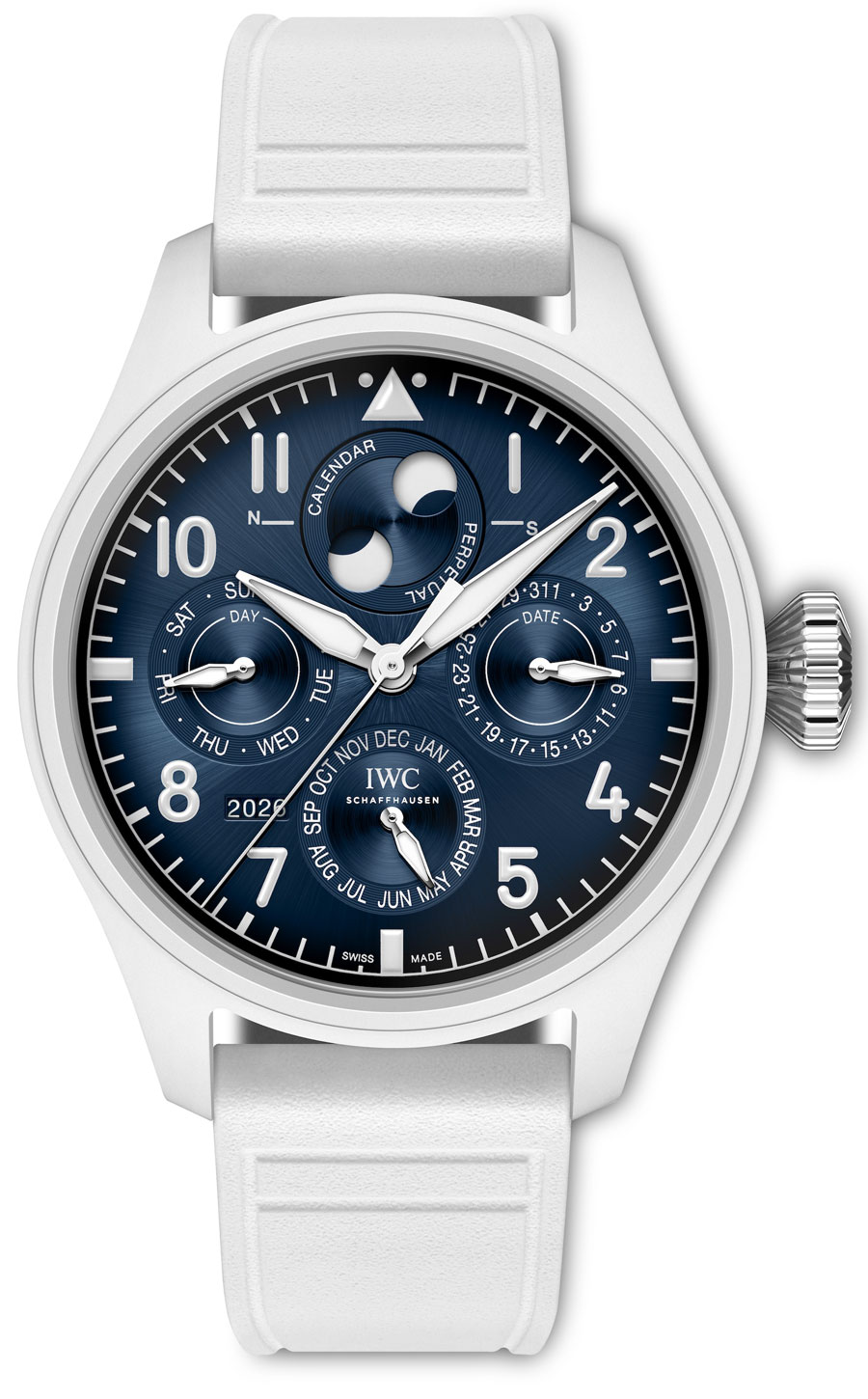
The real breakthrough lies in its fully synchronised, gear-driven architecture. For the first time in an IWC timepiece, the calendar is adjustable both forwards and backwards simply by turning the crown. No more correctors, no more convoluted setting sequences: the date, day, month, year, and moon phase all follow the crown’s movement in perfect harmony. This upgrade makes living with this complication day-to-day much smoother. This mechanism still automatically accounts for 30- and 31-day months, as well as leap years. It was also the opportunity for the brand to update the Double Moon™ display, which has now reached such a level of thoroughness that it will only deviate by a single day after 1,040 years. The 4-digit year display — a historic hallmark for the manufacture — remains in place as well.

A new generation of Perpetual Calendars
The Big Pilot’s Watch now highlights this innovation. It is available in steel, red gold, or a white ceramic “Le Petit Prince” edition, presented by Frank Sans C. The model is powered by the manufacture’s self-winding calibre. It features Pellaton winding and a silicon hairspring, alongside a nickel-phosphorus escapement. The timepiece boasts roughly a 60-hour power reserve.

With ProSet®, IWC does not aim to bring more complexity to its perpetual calendar. Conversely, it brings a more intuitive feel. Without the shadow of a doubt, it is the best upgrade for a centuries-old complication. Features haven’t been added, but eventually, with this use and look became smoother.
€40,900
Click here for the Big Pilot’s Perpetual Calendar ProSet Le Petit Prince
VACHERON CONSTANTIN, Traditionnelle Ultra-Thin Perpetual Calendar: challenging slenderness

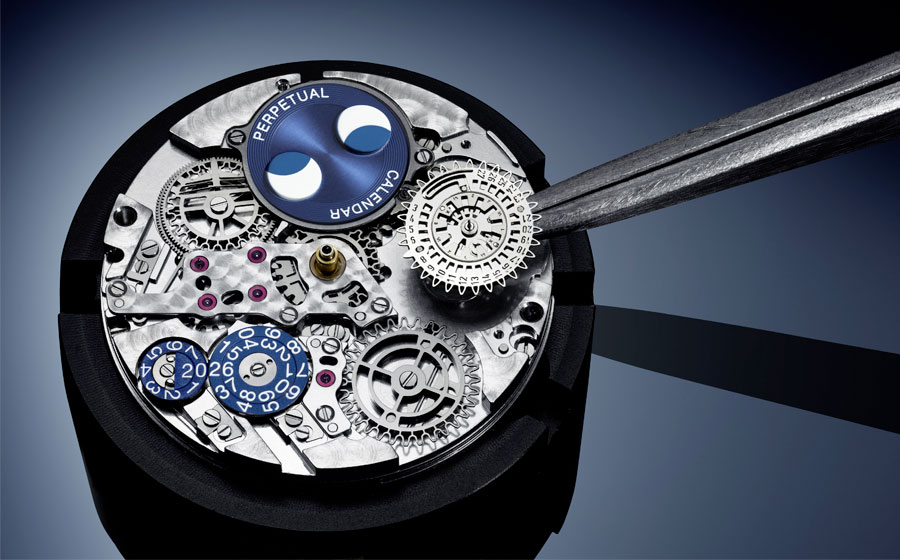
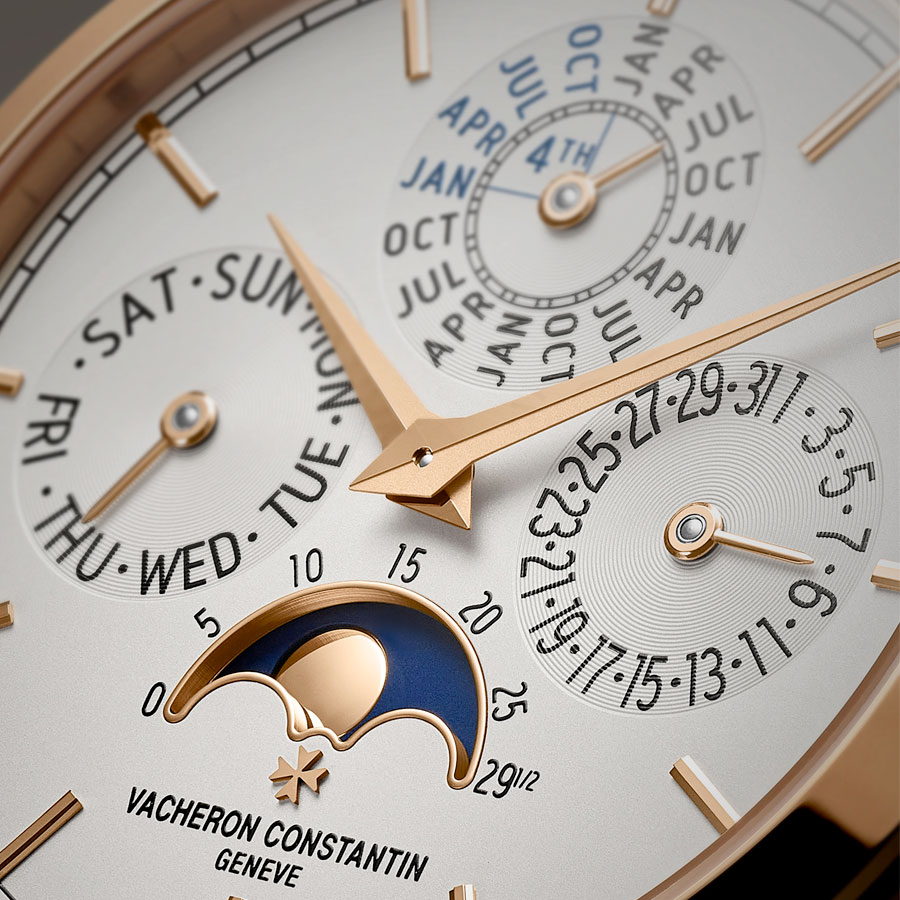
36.5 mm: this diameter was by no means chosen at random. It is inspired from the Reference 43031 launched in 1983. This model became an icon for the manufacture just as mechanical fine watchmaking survived the quartz crisis. Forty years on, Vacheron Constantin proves that a perpetual calendar doesn’t need a large case to remain perfectly legible. The day, date, month, leap-year cycle, and moon-phase indications preserve a well-balanced layout. Moreover, they take their design cues from the Traditionnelle lineup.
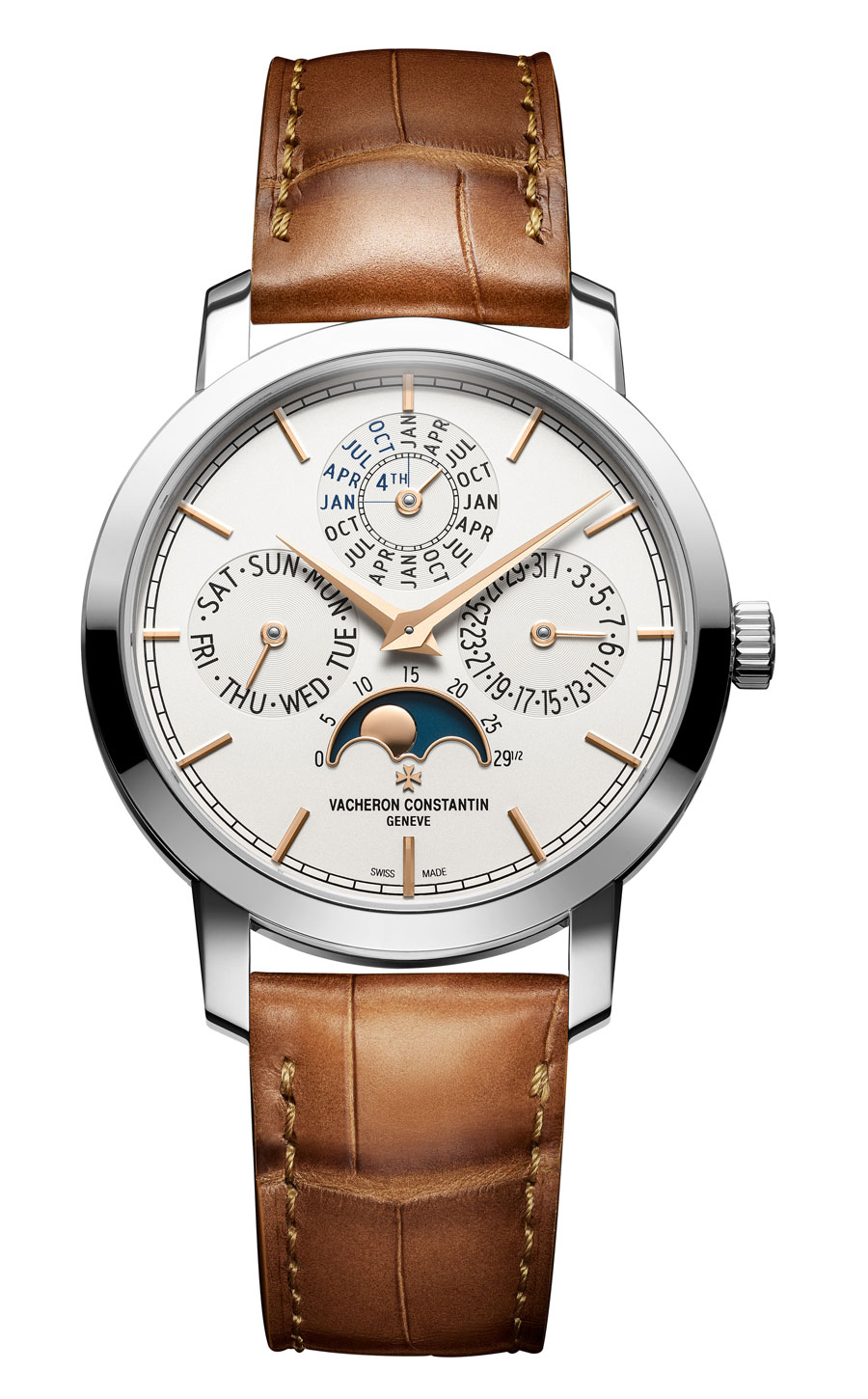
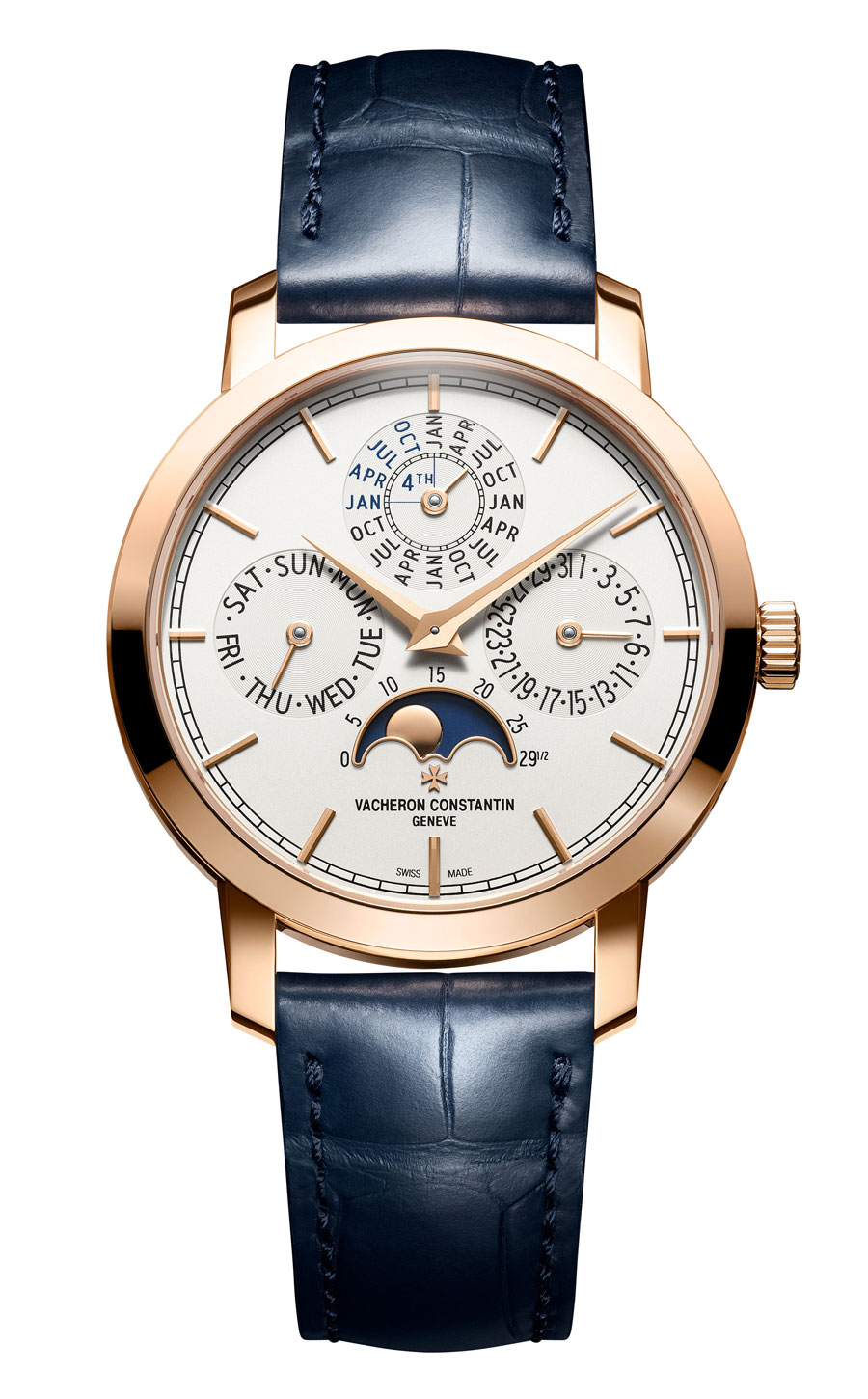
The silvered opaline dial houses the manufacture calibre, one of the brand’s greatest highlights. It measures a mere 4.05mm thick, although totalling 276 components. The self-winding movement showcases a know-how that Vacheron Constantin has honed for nearly a century. After all, ultra-thin watchmaking isn’t just about shaving off a few tenths of a millimetre. It strikes the perfect balance between slenderness, rigidity, and reliability. The perpetual calendar, which automatically accounts for varying month lengths and leap years until 2100, further upgrades this technical feat.
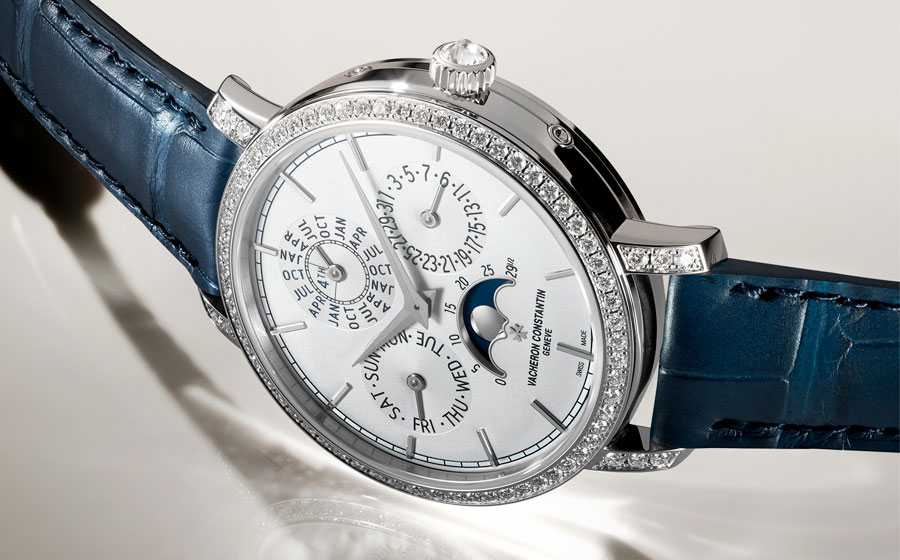
These three versions bring distinctive aesthetics: a pink gold edition with warm colourways, a white gold one enhanced by pink gold hands and hour markers, and a third reference set with diamonds. They all beat to the rhythm of an in-house self-winding calibre.
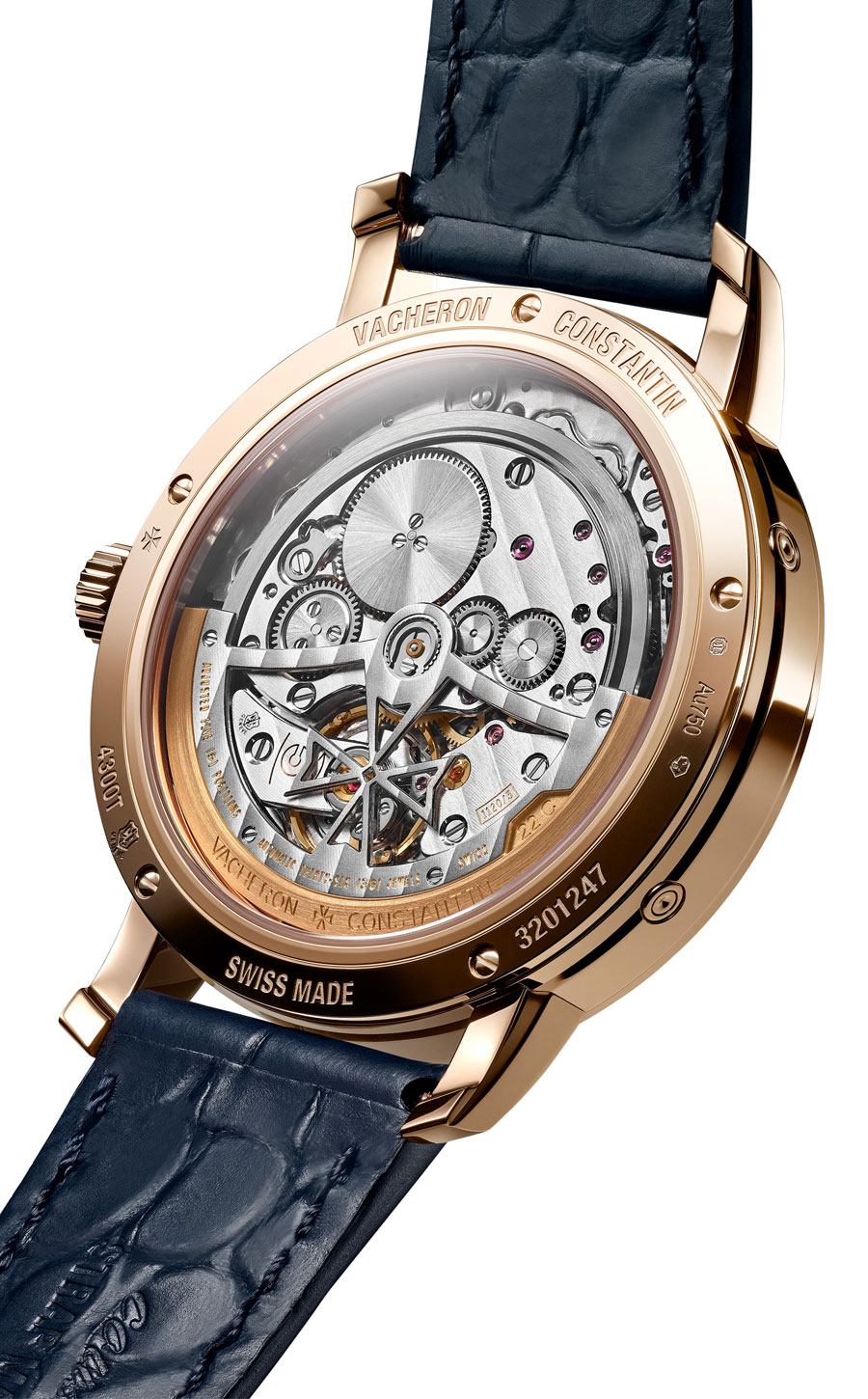
Visible through a sapphire case back, the movement features Côtes de Genève. It highlights an openworked oscillating weight in the shape of a Maltese cross — the brand’s hallmark. Fitted with a 22-carat gold segment, it ensures efficient winding. Each timepiece comes on a Mississippiensis alligator leather strap with tone-on-tone stitching, secured by a pin buckle. Water-resistant to 30 metres, they bear the highly prestigious Poinçon de Genève.
18-carat white gold with a diamond-set bezel version – €106,000
18-carat white gold version – €101,000
5N pink gold version – €101,000
See also:
Read also: